Blue-and-white Mockingbird

Blue-and-white Mockingbird

Melanotis hypoleucus

Silhouette: Sheatherius · PhyloPic

LCLeast ConcernNTVUENCR
Daily sighting probability ~10% · With luck
at Guatemala City

In 3 days ~40% in a week ~70%

701 Verified sightings at Guatemala City
84 In all 3 parks From 2019 to 2026
March Best month
☀️ Diurnal When it's spotted

About the Blue-and-white Mockingbird

The blue-and-white mockingbird (Melanotis hypoleucus) is a species of bird in the family Mimidae. It is found in El Salvador, Guatemala, Honduras, and Mexico. The blue-and-white mockingbird is monotypic. It and the blue mockingbird (Melanotis caerulescens) are the only species in their genus.

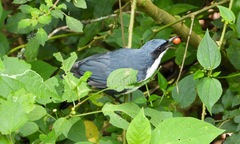
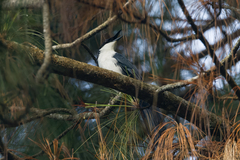
The blue-and-white mockingbird is 24.2 to 28 cm (9.5 to 11.0 in) long; 20 specimens had a mean mass of 68 g (2.4 oz). The adults' upperparts are a dull slate blue that is slightly brighter on the crown. The wings and tail are slaty black. A conspicuous black "mask" covers from the lores past the eye. The underparts are white darkening to bluish or slate gray on the flanks and vent area. The juvenile has a similar pattern but its upperparts are dull slaty gray instead of blue.

The blue-and-white mockingbird is a year round resident of Mexico from south of the Isthmus of Tehuantepec through Guatemala to El Salvador and southern Honduras. It inhabits a variety of landscapes including the edges of humid evergreen forest, pine-oak forest, second growth, and humid and semi-arid scrublands. In elevation it ranges between... Wikipedia →

Sounds

Song0:36

Guatemala · 2024

© Brendan Sloan · XC972676 · CC BY-NC-ND 4.0

Call0:40

El Salvador · 2016

© Guillermo Funes · XC343950 · CC BY-NC-SA 4.0

Call0:24

Mexico · 2015

© Frank Lambert · XC260220 · CC BY-NC-ND 4.0

Global Distribution

Parks Where Found

# Park Country Daily sighting probability
1 Cañón del Sumidero National Park 🇲🇽 Mexico
~10%
2 Celaque National Park 🇭🇳 Honduras
~10%
3 La Tigra National Park 🇭🇳 Honduras
<5%

Cities Where Found

# City Country Daily sighting probability
1 Guatemala City 🇬🇹 Guatemala
~10%

Before you go

What are the chances of seeing a Blue-and-white Mockingbird in Guatemala City?

With luck

About 10% of wildlife watchers report a Blue-and-white Mockingbird sighting in Guatemala City on a given day, based on 701 verified sightings from GBIF citizen-science data. It is the 46th most-seen of the 220 birds we can rate there. Over three days the chance rises to about 40%, and over a week to about 70%, if each day is a fresh chance.

When is the best time to see a Blue-and-white Mockingbird in Guatemala City?

March

In that month about 30% of wildlife watchers report a Blue-and-white Mockingbird in Guatemala City on a given day, against under 5% in September, the lowest month. That is one of Guatemala City's driest months, with about 10 mm of rain against 240 mm in September.

What time of day is best to see a Blue-and-white Mockingbird?

Between 6 and 9 am

Across all the parks we cover, that three-hour window holds the most Blue-and-white Mockingbird sightings with a recorded time, and about 9 in 10 of them come between 6 am and 6 pm: it is a daytime animal.

Where else can you see a Blue-and-white Mockingbird?

Only Guatemala City, in our data

Guatemala City is the only city on Wallace's Line with enough records to rate Blue-and-white Mockingbird sightings: about 10% of wildlife watchers there report one on a given day.

Where does the Blue-and-white Mockingbird sighting chance come from?

GBIF citizen-science records

It is estimated from how often the Blue-and-white Mockingbird is recorded against all the birds logged in Guatemala City (701 verified sightings), calibrated against known sighting rates. Figures are rounded to the nearest 10% because citizen-science data supports honest approximations, not decimals, and months with records from fewer than five people show "—". How it works.

← Back to Guatemala City