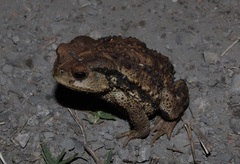
Asiatic Toad

Asiatic Toad

Bufo gargarizans

Silhouette: Steven Traver · PhyloPic

LCLeast ConcernNTVUENCR
Daily sighting probability ~40% · Likely
at Gwangju

In 3 days ~80% in a week >90%

5 Verified sightings at Gwangju
July Best month

About the Asiatic Toad

The Asiatic toad or Chusan Island toad (Bufo gargarizans) is a species of toad endemic to East Asia. The species was previously classified as Bufo bufo gargarizans, a subspecies of the common toad. It is common in China (specifically Anhui, Fujian, Gansu, Guizhou, Hebei, Heilongjiang, Henan, Hubei, Hunan, Inner Mongolia, Jiangsu, Jiangxi, Jilin, Qinghai, Shaanxi, Shandong, Shanxi, Sichuan, and Zhejiang) and portions of the Russian Far East (up north to the Amur River valley and on Sakhalin Island, and east to Transbaikalia in Siberia), but relatively rare on the Korean Peninsula. Asiatic toads are also found on the Miyako Islands of southern Japan, although they have been extirpated from some islands in recent years, possibly including Okinawa. The Miyako subspecies, Bufo gargarizans miyakonis, is also known as the Miyako toad.

The Asiatic toad avoids dense forests, but is found in most other habitats, including grasslands, open forests, meadows, and cultivated areas. It prefers humid areas, and is rarely found at altitudes of more than 800 meters.

The Asiatic toad plays an important role in traditional Chinese medicine.... Wikipedia →

Global Distribution

Parks Where Found

# Park Country Daily sighting probability

More parks will be added in future updates.

Cities Where Found

# City Country Daily sighting probability
1 Tianjin 🇨🇳 China
~50%
2 Guiyang 🇨🇳 China
~50%
3 Hefei 🇨🇳 China
~50%
4 Ningbo 🇨🇳 China
~50%
5 Gwangju 🇰🇷 South Korea
~40%
6 Nanjing 🇨🇳 China
~40%
7 Chongqing 🇨🇳 China
~40%
8 Shanghai 🇨🇳 China
~40%
9 Hangzhou 🇨🇳 China
~40%
10 Xi'an 🇨🇳 China
~40%

Zoos & Centres Where Found

# Zoo / Centre Country
1 Okinawa Zoo & Museum 🇯🇵 Japan In captivity

Before you go

What are the chances of seeing an Asiatic Toad in Gwangju?

Likely

About 40% of wildlife watchers report an Asiatic Toad sighting in Gwangju on a given day, based on 5 verified sightings from GBIF citizen-science data. Over three days the chance rises to about 80%, and over a week to over 90%, if each day is a fresh chance.

When is the best time to see an Asiatic Toad in Gwangju?

June–July and September

In those months about 60% of wildlife watchers report an Asiatic Toad in Gwangju on a given day, against about 10% in April–May and November, the lowest months. Those are among Gwangju's wettest months, with about 200 mm of rain a month against 30 mm in January. December to March have too few records to rate.

Is Gwangju the best place to see an Asiatic Toad?

5th of 21

Of the 21 cities where we can rate Asiatic Toad sightings, Gwangju ranks 5th at about 40%. The best odds are in Tianjin (China, about 50%), Guiyang (China, about 50%) and Hefei (China, about 50%).

Where does the Asiatic Toad sighting chance come from?

GBIF citizen-science records

It is estimated from how often the Asiatic Toad is recorded against all the amphibians logged in Gwangju (5 verified sightings), calibrated against known sighting rates. Figures are rounded to the nearest 10% because citizen-science data supports honest approximations, not decimals, and months with records from fewer than five people show "—". How it works.

← Back to Gwangju