About the Asian Giant Hornet
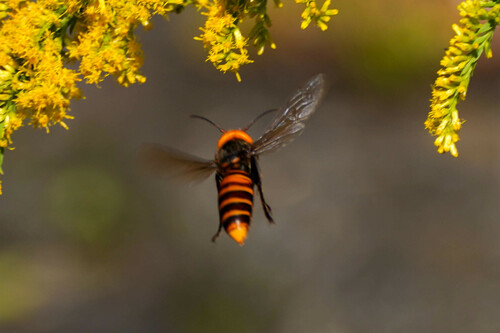
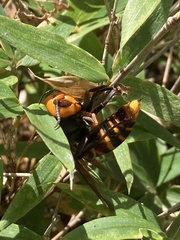
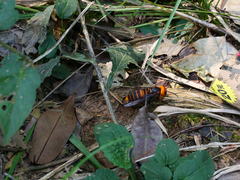
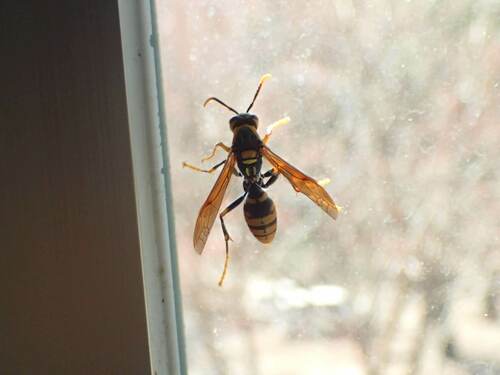
The Asian giant hornet (Vespa mandarinia), also known as the northern giant hornet, is the world's largest hornet. It is native to temperate and tropical East Asia, South Asia, mainland Southeast Asia, and parts of the Russian Far East. It was also briefly found in the Pacific Northwest of North America from late 2019 but was eradicated by December 2024.
Asian giant hornets prefer to live in low mountains and forests, while almost completely avoiding plains and high-altitude climates. They create nests by digging, co-opting pre-existing tunnels dug by rodents, or occupying spaces near rotten pine roots. The Asian giant hornet feeds primarily on larger insects, colonies of other eusocial insects, tree sap, and honey from honeybee colonies. It has a body length of 45 mm (1+3⁄4 in), a wingspan around 75 mm (3 in), and a stinger 6 mm (1⁄4 in) long, which injects a large amount of potent venom.
V. mandarinia is a species in the genus Vespa, which comprises all true hornets. Along with seven other species, V. mandarinia is a part of the V. tropica species group, defined by the single notch located on the apical margin of the seventh gastral sternum of the male... Wikipedia →