Chinese Flying Frog

Chinese Flying Frog

Zhangixalus dennysi

Silhouette: Jose Carlos Arenas-Monroy · PhyloPic

LCLeast ConcernNTVUENCR
Daily sighting probability ~20% · Possible
at Hangzhou

In 3 days ~40% in a week ~70%

24 Verified sightings at Hangzhou
11 In 1 park From 2019 to 2026
August Best month
☀️ Diurnal When it's spotted

About the Chinese Flying Frog

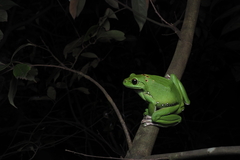
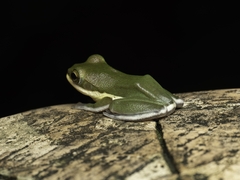
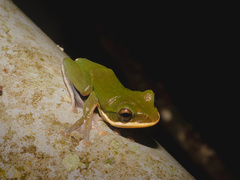
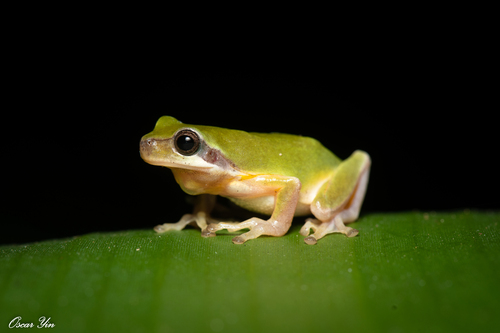
The Chinese flying frog or Chinese gliding frog (Zhangixalus dennysi) is a species of tree frog in the family Rhacophoridae found in China, Laos, Myanmar, and Vietnam. It is also known as Blanford's whipping frog, large treefrog, and Denny's whipping frog.

It is up to 10 cm (3.9 in) long and has an unusually loud call. This frog has adhesive disks on its toes for climbing and sticking to trees and branches. It also has large amounts of webbed skin between its toes. When it jumps from a branch, the skin stretches, allowing the frog to glide between branches or between trees. The frog can move its feet mid-air to steer.

This frog lives in moist forests in lowlands, mountains, and on hills near streams. This frog tends to live in primary forest. It has been observed between 80 and 1500 meters above sea level. This frog feeds on insects. Females lay eggs in foam nests attached to branches and grasses hanging over water. They create nests by beating a frothy secretion into foam with their hind legs. The tadpoles develop in paddy fields, holes full of water, ponds, and marshes.

The IUCN classifies this species as least concern... Wikipedia →

Sounds

Recording0:07

China · 2026

© Amaël Borzée · iNaturalist · CC BY-NC 4.0

Recording0:04

2024

© uncontacted tribe · iNaturalist · CC BY-NC 4.0

Recording0:08

China · 2026

© Dallin Kohler · iNaturalist · CC BY-NC 4.0

Global Distribution

Parks Where Found

# Park Country Daily sighting probability
1 Cuc Phuong National Park 🇻🇳 Vietnam
~40%

More parks will be added in future updates.

Cities Where Found

# City Country Daily sighting probability
1 Hangzhou 🇨🇳 China
~20%

Zoos & Centres Where Found

# Zoo / Centre Country
1 Beijing Wildlife Park 🇨🇳 China In captivity
2 Toronto Zoo 🇨🇦 Canada In captivity
3 Warsaw Zoo 🇵🇱 Poland In captivity
4 Łódź Zoo 🇵🇱 Poland In captivity
5 Plock Zoo 🇵🇱 Poland In captivity
6 Zamość Zoo 🇵🇱 Poland In captivity
7 Leningrad Zoo 🇷🇺 Russia In captivity
8 herpetarium warszawskiego ZOO 🇵🇱 Poland In captivity
9 akwarium warszawskiego ZOO 🇵🇱 Poland In captivity
10 hipopotamiarnia i akwarium morskie warszawskiego ZOO 🇵🇱 Poland In captivity

Before you go

What are the chances of seeing a Chinese Flying Frog in Hangzhou?

Possible

About 20% of wildlife watchers report a Chinese Flying Frog sighting in Hangzhou on a given day, based on 24 verified sightings from GBIF citizen-science data. It is the 8th most-seen of the 13 amphibians we can rate there. Over three days the chance rises to about 40%, and over a week to about 70%, if each day is a fresh chance.

When is the best time to see a Chinese Flying Frog in Hangzhou?

July and August

In those months about 30% of wildlife watchers report a Chinese Flying Frog in Hangzhou on a given day, against under 5% in September–October and December–March, the lowest months.

What time of day is best to see a Chinese Flying Frog?

Between 2 and 5 pm

Across all the parks we cover, that three-hour window holds the most Chinese Flying Frog sightings with a recorded time, and about 8 in 10 of them come between 6 am and 6 pm: it is a daytime animal.

Where else can you see a Chinese Flying Frog?

Only Hangzhou, in our data

Hangzhou is the only city on Wallace's Line with enough records to rate Chinese Flying Frog sightings: about 20% of wildlife watchers there report one on a given day.

Where does the Chinese Flying Frog sighting chance come from?

GBIF citizen-science records

It is estimated from how often the Chinese Flying Frog is recorded against all the amphibians logged in Hangzhou (24 verified sightings), calibrated against known sighting rates. Figures are rounded to the nearest 10% because citizen-science data supports honest approximations, not decimals, and months with records from fewer than five people show "—". How it works.

← Back to Hangzhou