Northern Curly-tailed Lizard

Northern Curly-tailed Lizard

Leiocephalus carinatus

Silhouette: Caleb M. Gordon · PhyloPic

LCLeast ConcernNTVUENCR
Daily sighting probability ~40% · Likely
at Havana

In 3 days ~70% in a week >90%

7 Verified sightings at Havana
1,193 In all 4 parks From 2019 to 2026
September Best month
☀️ Diurnal When it's spotted

About the Northern Curly-tailed Lizard

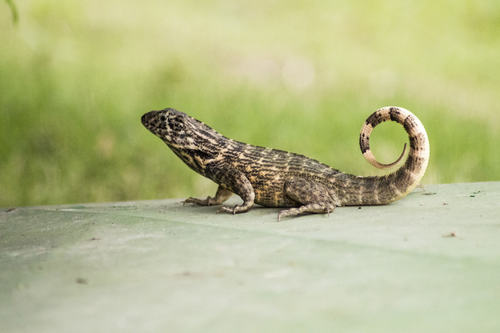
Leiocephalus carinatus, commonly known as the northern curly-tailed lizard or saw-scaled curlytail, is a species of lizard in the family Leiocephalidae (curly-tailed lizard). It is native to the Bahama Islands, the Cayman Islands and Cuba. It was introduced intentionally in Palm Beach, Florida, in the 1940s in an attempt to control sugar cane pests, and is now also present in a few other parts of the state. Another introduced population inhabits Swan Islands, Honduras.

Adults may attain a snout to vent length (SVL) of 10.5 cm (4.1 in), or a total length, including the tail, of 26 cm (10 in). The dorsal scales are keeled and pointed. L. carinatus resembles lizards of the genus Sceloporus, but with the tail usually curled upward, especially when the lizard is in a horizontal position on rocks or on the ground.

An active, robust lizard, it is mostly terrestrial and will retreat into a burrow or cavity when frightened. It prefers sunny areas with loose rubble and rock. In the Cayman Islands a large captured specimen was observed to consistently burrow completely under the sand in a holding tank, even though a rock retreat was provided... Wikipedia →
Global Distribution

Parks Where Found

# Park Country Daily sighting probability
1 Everglades National Park 🇺🇸 United States
~60%
2 Big Cypress National Preserve 🇺🇸 United States
~50%
3 Ciénaga de Zapata 🇨🇺 Cuba
~20%
4 Merritt Island National Wildlife Refuge 🇺🇸 United States
~10%

Cities Where Found

# City Country Daily sighting probability
1 Miami 🇺🇸 United States
~50%
2 Havana 🇨🇺 Cuba
~40%
3 Orlando 🇺🇸 United States
~10%

Zoos & Centres Where Found

# Zoo / Centre Country
1 Prague Zoo 🇨🇿 Czechia In captivity
2 Wrocław Zoological Garden 🇵🇱 Poland In captivity
3 Budapest Zoo & Botanical Garden 🇭🇺 Hungary In captivity
4 Africarium 🇵🇱 Poland In captivity
5 Rákosův pavilon 🇨🇿 Czechia In captivity
6 Velemlokárium 🇨🇿 Czechia In captivity
7 San Antonio Aquarium 🇺🇸 United States In captivity
8 terrarium ogrodu zoologicznego we Wrocławiu 🇵🇱 Poland In captivity

Before you go

What are the chances of seeing a Northern Curly-tailed Lizard in Havana?

Likely

About 40% of wildlife watchers report a Northern Curly-tailed Lizard sighting in Havana on a given day, based on 7 verified sightings from GBIF citizen-science data. It is the 4th most-seen of the 5 reptiles we can rate there. Over three days the chance rises to about 70%, and over a week to over 90%, if each day is a fresh chance.

When is the best time to see a Northern Curly-tailed Lizard in Havana?

September

In that month about 70% of wildlife watchers report a Northern Curly-tailed Lizard in Havana on a given day, against about 10% in January, March–May, July–August and November, the lowest months. That is one of Havana's wettest months, with about 100 mm of rain against 25 mm in March.

What time of day is best to see a Northern Curly-tailed Lizard?

Between 4 and 7 pm

Across all the parks we cover, that three-hour window holds the most Northern Curly-tailed Lizard sightings with a recorded time, and about 8 in 10 of them come between 6 am and 6 pm: it is a daytime animal.

Is Havana the best place to see a Northern Curly-tailed Lizard?

2nd of 3

Of the 3 cities where we can rate Northern Curly-tailed Lizard sightings, Havana ranks 2nd at about 40%. The best odds are in Miami (United States, about 50%).

Where does the Northern Curly-tailed Lizard sighting chance come from?

GBIF citizen-science records

It is estimated from how often the Northern Curly-tailed Lizard is recorded against all the reptiles logged in Havana (7 verified sightings), calibrated against known sighting rates. Figures are rounded to the nearest 10% because citizen-science data supports honest approximations, not decimals, and months with records from fewer than five people show "—". How it works.

← Back to Havana
