Butterfly Flutterer

Butterfly Flutterer

Rhyothemis fuliginosa

Daily sighting probability ~20% · Possible
at Hiroshima

In 3 days ~50% in a week ~80%

6 Verified sightings at Hiroshima
July Best month

About the Butterfly Flutterer

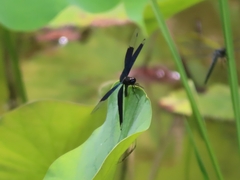
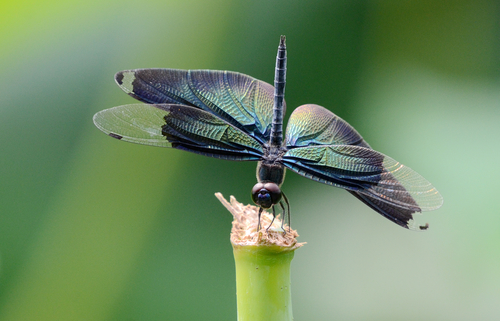
Rhyothemis fuliginosa, also known as the butterfly dragonfly or the butterfly flutterer, is a species of dragonfly of the family Libellulidae found throughout East Asia, in the countries of Japan, China, Taiwan, and the Korean Peninsula.

In Japan, R. fuliginosa is known as チョウトンボ (chou-tonbo, 蝶蜻蛉) which directly translates to "butterfly dragonfly." In China and Taiwan, it is known as 黑翅蜻蜓 (Hēi chì qīngtíng), meaning "black-winged dragonfly." In Korea it is also known as 나비잠자리 (Nabi jamjari) meaning "butterfly dragonfly".

Flights occur between the months of June and September. They are most active from early summer to the mid-autumn season. Rhyothemis fuliginosa is a short and stout dragonfly with a body length of 32-41 millimeters in length. The wings are 30–40 mm across and patterned with a deep blue iridescent shade. Depending on the viewing angle, the dragonfly's wings can vary in color due to their light scattering properties, with some appearing golden in the light. The wing patterns are thought to be a determinant between members of the same species to avoid mating with the incorrect partner.

Males have spots on the tips of their hindwings, a feature that allows... Wikipedia →
Global Distribution

Parks Where Found

# Park Country Daily sighting probability

More parks will be added in future updates.

Cities Where Found

# City Country Daily sighting probability
1 Hiroshima 🇯🇵 Japan
~20%
2 Daegu 🇰🇷 South Korea
~20%
3 Suzhou 🇨🇳 China
~20%
4 Changsha 🇨🇳 China
~10%
5 Beijing 🇨🇳 China
~10%
6 Wuhan 🇨🇳 China
~10%
7 Seoul 🇰🇷 South Korea
~10%
8 Nanjing 🇨🇳 China
~10%
9 Osaka 🇯🇵 Japan
~10%
10 Hangzhou 🇨🇳 China
~10%

Before you go

What are the chances of seeing a Butterfly Flutterer in Hiroshima?

Possible

About 20% of wildlife watchers report a Butterfly Flutterer sighting in Hiroshima on a given day, based on 6 verified sightings from GBIF citizen-science data. It is the 11th most-seen of the 14 insects we can rate there. Over three days the chance rises to about 50%, and over a week to about 80%, if each day is a fresh chance.

When is the best time to see a Butterfly Flutterer in Hiroshima?

July

In that month about 50% of wildlife watchers report a Butterfly Flutterer in Hiroshima on a given day, against under 5% in February–May and August–December, the lowest months. That is one of Hiroshima's wettest months, with about 260 mm of rain against 65 mm in January.

Is Hiroshima the best place to see a Butterfly Flutterer?

Yes

Of the 12 cities where we can rate Butterfly Flutterer sightings, Hiroshima has the highest daily chance: about 20%. Next come Daegu (South Korea, about 20%) and Suzhou (China, about 20%).

Where does the Butterfly Flutterer sighting chance come from?

GBIF citizen-science records

It is estimated from how often the Butterfly Flutterer is recorded against all the insects logged in Hiroshima (6 verified sightings), calibrated against known sighting rates. Figures are rounded to the nearest 10% because citizen-science data supports honest approximations, not decimals, and months with records from fewer than five people show "—". How it works.

← Back to Hiroshima