Tristram's Starling

Tristram's Starling

Onychognathus tristramii

LCLeast ConcernNTVUENCR
Daily sighting probability <5% · Rare
at Jerusalem

In 3 days ~10% in a week ~20%

140 Verified sightings at Jerusalem
June Best month
☀️ Diurnal When it's spotted

About the Tristram's Starling

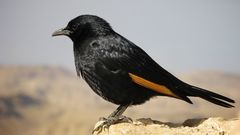
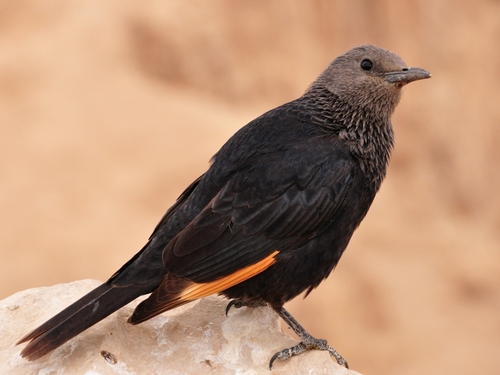
Tristram's starling (Onychognathus tristramii), also known as Dead Sea starling or Tristram's grackle, is a species of starling native to the Middle East. It is the only member of the genus Onychognathus found mainly outside of Africa. The species is named after Reverend Henry Baker Tristram, who collected natural history specimens.

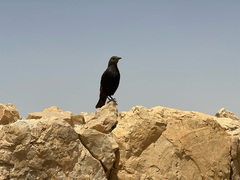
This bird is found in deserts in Israel, Palestine, Jordan, northeastern Egypt (Sinai Peninsula), (NEOM) ([Magna]), western Saudi Arabia, Yemen, and Oman, nesting mainly on rocky cliff faces. The species is becoming increasingly commensal with humans, feeding in towns and villages; this has enabled a recent northward spread in its distribution.

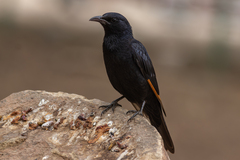
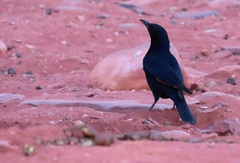
Tristram's starling is 25 cm long (including a 9 cm tail), with a wingspan of 44–45 cm, and a weight of 100–140 g. The males have glossy iridescent black plumage with orange patches on the outer wing, which are particularly noticeable in flight. The bill and legs are black. Females and young birds are similar but duller and with a greyish head, lacking the plumage gloss.

Although starlings are a tropical family by origin, Tristram's starling is well... Wikipedia →
Global Distribution

Parks Where Found

# Park Country Daily sighting probability

More parks will be added in future updates.

Cities Where Found

# City Country Daily sighting probability
1 Ramallah 🇵🇸 Palestine
~10%
2 Jerusalem 🇮🇱 Israel
<5%

Before you go

What are the chances of seeing a Tristram's Starling in Jerusalem?

Rare

Under 5% of wildlife watchers report a Tristram's Starling sighting in Jerusalem on a given day, based on 140 verified sightings from GBIF citizen-science data. It is the 105th most-seen of the 192 birds we can rate there. Over three days the chance rises to about 10%, and over a week to about 20%, if each day is a fresh chance.

When is the best time to see a Tristram's Starling in Jerusalem?

June

In that month about 10% of wildlife watchers report a Tristram's Starling in Jerusalem on a given day, against under 5% in July to May, the lowest months. That is one of Jerusalem's driest months, with almost no rain against 90 mm in January.

What time of day is best to see a Tristram's Starling?

Between 9 am and noon

Across all the parks we cover, that three-hour window holds the most Tristram's Starling sightings with a recorded time, and about 9 in 10 of them come between 6 am and 6 pm: it is a daytime animal.

Is Jerusalem the best place to see a Tristram's Starling?

2nd of 2

Of the 2 cities where we can rate Tristram's Starling sightings, Jerusalem ranks 2nd at under 5%. The best odds are in Ramallah (Palestine, about 10%).

Where does the Tristram's Starling sighting chance come from?

GBIF citizen-science records

It is estimated from how often the Tristram's Starling is recorded against all the birds logged in Jerusalem (140 verified sightings), calibrated against known sighting rates. Figures are rounded to the nearest 10% because citizen-science data supports honest approximations, not decimals, and months with records from fewer than five people show "—". How it works.

← Back to Jerusalem