Black-headed Jay

Black-headed Jay

Garrulus lanceolatus

Silhouette: Martin Bulla, based on Brian Small's illustration · PhyloPic

LCLeast ConcernNTVUENCR
Daily sighting probability <5% · Rare
at Kathmandu

In 3 days <5%

7 Verified sightings at Kathmandu
November Best month
☀️ Diurnal When it's spotted

About the Black-headed Jay

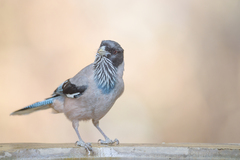
The black-headed jay or lanceolated jay (Garrulus lanceolatus) is a species of passerine bird in the crow family Corvidae. It is found in open wooded country across the Himalayas and into eastern Afghanistan. A relatively large songbird, it has a largely grey body with a black head, an untidy crest, white streaks on the throat, and a pale bill. It is roughly the same size as its close relative the Eurasian jay, but a little more slender overall.

The black-headed jay was formally described by the Irish zoologist Nicholas Aylward Vigors in 1830. It is one of three species placed in the genus Garrulus that was established in 1760 by the French zoologist Mathurin Jacques Brisson. The genus name Garrulus is a Latin word meaning "chattering", "babbling" or "noisy". The specific epithet lanceolatus is Latin for "lance-shaped" or "spear-shaped", from lancea meaning "lance".

The black-headed jay is roughly the same size as its close relative the Eurasian jay, but a little more slender overall. The head is mostly black with white streaks on the throat and a more obvious crest compared to the Eurasian jay. The bill is pale and slightly shorter and thicker compared... Wikipedia →

Sounds

Call0:14

India · 2019

© Andrew Spencer · XC547771 · CC BY-NC-ND 4.0

Begging call0:12

India · 2019

© Prashant Kumar · XC492383 · CC BY-NC-SA 4.0

Alarm call0:52

Nepal · 2023

© Greg Irving · XC788519 · CC BY-NC-SA 4.0

Global Distribution

Parks Where Found

# Park Country Daily sighting probability

More parks will be added in future updates.

Cities Where Found

# City Country Daily sighting probability
1 Kathmandu 🇳🇵 Nepal
<5%

Before you go

What are the chances of seeing a Black-headed Jay in Kathmandu?

Rare

Under 5% of wildlife watchers report a Black-headed Jay sighting in Kathmandu on a given day, based on 7 verified sightings from GBIF citizen-science data. It is the 297th most-seen of the 312 birds we can rate there. Over three days the chance rises to under 5%, if each day is a fresh chance.

When is the best time to see a Black-headed Jay in Kathmandu?

Any time of year

In every month with enough records, under 5% of wildlife watchers report a Black-headed Jay in Kathmandu on a given day, so our monthly data shows no clear season.

What time of day is best to see a Black-headed Jay?

Between 6 and 9 am

Across all the parks we cover, that three-hour window holds the most Black-headed Jay sightings with a recorded time, and about 9 in 10 of them come between 6 am and 6 pm: it is a daytime animal.

Where else can you see a Black-headed Jay?

Only Kathmandu, in our data

Kathmandu is the only city on Wallace's Line with enough records to rate Black-headed Jay sightings: under 5% of wildlife watchers there report one on a given day.

Which relatives of the Black-headed Jay live in Kathmandu?

Same family: Corvidae

The closest relatives of the Black-headed Jay that you can see in Kathmandu (family Corvidae, Crows, Jays, and Magpies) are House Crow (about 90%), Large-billed Crow (about 50%) and Gray Treepie (about 20%), with each one's daily chance of a sighting.

Where does the Black-headed Jay sighting chance come from?

GBIF citizen-science records

It is estimated from how often the Black-headed Jay is recorded against all the birds logged in Kathmandu (7 verified sightings), calibrated against known sighting rates. Figures are rounded to the nearest 10% because citizen-science data supports honest approximations, not decimals, and months with records from fewer than five people show "—". How it works.

← Back to Kathmandu