Rock Eagle-Owl

Rock Eagle-Owl

Bubo bengalensis

Silhouette: Steven Traver · PhyloPic

LCLeast ConcernNTVUENCR
Daily sighting probability <5% · Rare
at Kathmandu

In 3 days <5%

22 Verified sightings at Kathmandu
8 In 1 park From 2019 to 2026
January Best month

About the Rock Eagle-Owl

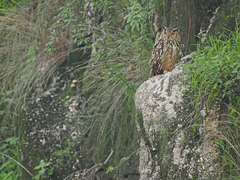
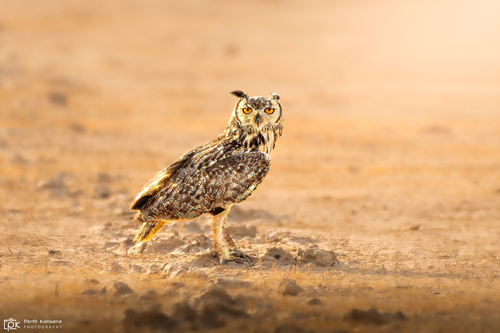
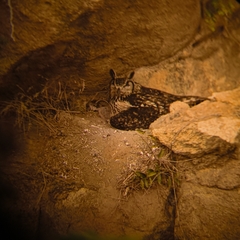
The Indian eagle-owl (Bubo bengalensis), or the Bengal eagle-owl or rock eagle-owl, is a large horned owl species native to hilly and rocky scrub forests in the Indian subcontinent. It is splashed with brown and grey, and has a white throat patch with black small stripes. It was earlier treated as a subspecies of the Eurasian eagle-owl. It is usually seen in pairs. It has a deep resonant booming call that may be heard at dawn and dusk.

Bubo bengalensis was the scientific name used by James Franklin in 1831 for an eagle-owl, that was collected in northern India. This species is often considered a subspecies of the Eurasian eagle-owl Bubo bubo and is very similar in appearance. The facial disk is unmarked and has a black border, a feature that is much weaker in the Eurasian form. The base of the primaries is unbanded and rufous. The tail bands have the tawny bands wider than the black ones. Additionally, a large pale scapular patch is visible on the folded wing. The inner claws are the longest. The last joint of the toes are unfeathered.

The taxonomy of the group is complex due to a large amount of variation. Dementiev was the first to consider the possibility... Wikipedia →
Sounds

Call0:22

India · 2024

© Jairam Vijayan · XC878419 · CC BY-SA 4.0

Song0:30

India · 2016

© Frank Lambert · XC409708 · CC BY-NC-ND 4.0

Call0:55

India · 2021

© Kandarp Andharia · XC663623 · CC BY-NC-SA 4.0

Global Distribution

Parks Where Found

# Park Country Daily sighting probability
1 Royal Bardia National Park 🇳🇵 Nepal
<5%

More parks will be added in future updates.

Cities Where Found

# City Country Daily sighting probability
1 Kathmandu 🇳🇵 Nepal
<5%

Zoos & Centres Where Found

# Zoo / Centre Country
1 Nehru Zoological Park 🇮🇳 India In captivity
2 Sakkarbaug Zoological Garden 🇮🇳 India In captivity
3 Sanjay Gandhi Biological Park 🇮🇳 India In captivity
4 Parco Natura Viva 🇮🇹 Italy In captivity
5 Diergaarde Blijdorp 🇳🇱 Netherlands In captivity
6 Kamla Nehru Prani Sangrahalay 🇮🇳 India In captivity
7 Bandung Zoo 🇮🇩 Indonesia In captivity
8 Seville Zoo 🇪🇸 Spain In captivity
9 Marcelle Natureza 🇪🇸 Spain In captivity
10 Kathmandu Zoo 🇳🇵 Nepal In captivity
11 World of Birds Wildlife Sanctuary and Monkey Park 🇿🇦 South Africa In captivity
12 Parc Animalier de Serre-Ponçon 🇫🇷 France In captivity
13 The Eagles of Aure 🇫🇷 France In captivity
14 Oceanium 🇳🇱 Netherlands In captivity
15 Bristol Aquarium 🇬🇧 United Kingdom In captivity
16 Centro Volo Rapaci 🇮🇹 Italy In captivity
17 Rohtak Zoo 🇮🇳 India In captivity

Before you go

What are the chances of seeing a Rock Eagle-Owl in Kathmandu?

Rare

Under 5% of wildlife watchers report a Rock Eagle-Owl sighting in Kathmandu on a given day, based on 22 verified sightings from GBIF citizen-science data. It is the 261st most-seen of the 312 birds we can rate there. Over three days the chance rises to under 5%, if each day is a fresh chance.

When is the best time to see a Rock Eagle-Owl in Kathmandu?

Any time of year

In every month with enough records, under 5% of wildlife watchers report a Rock Eagle-Owl in Kathmandu on a given day, so our monthly data shows no clear season.

Where else can you see a Rock Eagle-Owl?

Only Kathmandu, in our data

Kathmandu is the only city on Wallace's Line with enough records to rate Rock Eagle-Owl sightings: under 5% of wildlife watchers there report one on a given day.

Where does the Rock Eagle-Owl sighting chance come from?

GBIF citizen-science records

It is estimated from how often the Rock Eagle-Owl is recorded against all the birds logged in Kathmandu (22 verified sightings), calibrated against known sighting rates. Figures are rounded to the nearest 10% because citizen-science data supports honest approximations, not decimals, and months with records from fewer than five people show "—". How it works.

← Back to Kathmandu