Red Palm Weevil

Red Palm Weevil

Rhynchophorus ferrugineus

Daily sighting probability ~10% · With luck
at Kochi

In 3 days ~20% in a week ~30%

14 Verified sightings at Kochi
October Best month

About the Red Palm Weevil

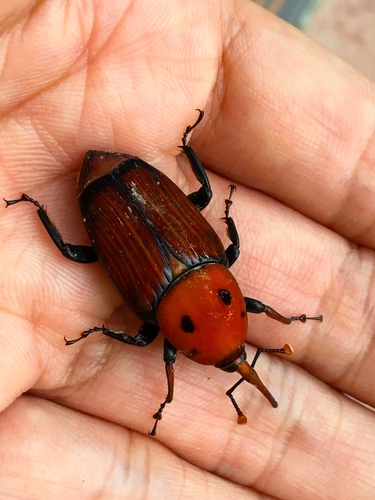
The palm weevil Rhynchophorus ferrugineus is one of two species of snout beetle known as the red palm weevil, Asian palm weevil or sago palm weevil. The adult beetles are relatively large, ranging between 2 and 4 centimetres (1 and 1+1⁄2 inches) long, and are usually a rusty red colour—but many colour variants exist and have often been classified as different species (e.g., R. vulneratus). Weevil larvae can excavate holes in the trunks of palm trees up to 1 metre (3.3 ft) long, thereby weakening and eventually killing the host plant. As a result, the weevil is considered a major pest in palm plantations, including the coconut palm, date palm and oil palm.

Originally from tropical Asia, the red palm weevil has spread to Africa and Europe, reaching the Mediterranean in the 1980s. It was first recorded in Spain in 1994, and in France in 2006. Additional infestations have been located in Malta, Italy (Tuscany, Sicily, Campania, Sardinia, Lazio, Marche, Puglia and Liguria), Croatia and Montenegro. It is also well established throughout most of Portugal, especially in the South. It also has established in Morocco, Tunisia, and other North African countries. The weevil was first reported in the Americas on Curaçao in January 2009 and sighted the same year in Aruba. It was reported in the United States at Laguna Beach, California late in 2010 but this was a misidentification of the closely related species, R. vulneratus, and it did not become established.It was reported in Uruguay in March 2022, and has since spread to many parts of the country.

Larvae of Rhynchophorus ferrugineus are considered a delicacy in Southeast Asian cuisine. In some regions, however, larvae farming is strictly prohibited to prevent the potential devastation of plantation crops. Wikipedia →
Global Distribution

Parks Where Found

# Park Country Daily sighting probability

More parks will be added in future updates.

Cities Where Found

# City Country Daily sighting probability
1 Kunming 🇨🇳 China
~20%
2 Montevideo 🇺🇾 Uruguay
~20%
3 Valencia 🇪🇸 Spain
~20%
4 Naples 🇮🇹 Italy
~10%
5 Athens 🇬🇷 Greece
~10%
6 Rome 🇮🇹 Italy
~10%
7 Lisbon 🇵🇹 Portugal
~10%
8 Shanghai 🇨🇳 China
~10%
9 Colombo [Sri Jayawardenepura Kotte] 🇱🇰 Sri Lanka
~10%
10 Barcelona 🇪🇸 Spain
~10%

Before you go

What are the chances of seeing a Red Palm Weevil in Kochi?

With luck

About 10% of wildlife watchers report a Red Palm Weevil sighting in Kochi on a given day, based on 14 verified sightings from GBIF citizen-science data. It is the 216th most-seen of the 428 insects we can rate there. Over three days the chance rises to about 20%, and over a week to about 30%, if each day is a fresh chance.

When is the best time to see a Red Palm Weevil in Kochi?

June, September–October and December–January

In those months about 10% of wildlife watchers report a Red Palm Weevil in Kochi on a given day, against under 5% in February–May, July–August and November, the lowest months.

Is Kochi the best place to see a Red Palm Weevil?

12th of 14

Of the 14 cities where we can rate Red Palm Weevil sightings, Kochi ranks 12th at about 10%. The best odds are in Kunming (China, about 20%), Montevideo (Uruguay, about 20%) and Valencia (Spain, about 20%).

Where does the Red Palm Weevil sighting chance come from?

GBIF citizen-science records

It is estimated from how often the Red Palm Weevil is recorded against all the insects logged in Kochi (14 verified sightings), calibrated against known sighting rates. Figures are rounded to the nearest 10% because citizen-science data supports honest approximations, not decimals, and months with records from fewer than five people show "—". How it works.

← Back to Kochi