Wagler's Pit Viper

Wagler's Pit Viper

Tropidolaemus wagleri

Silhouette: Steven Traver · PhyloPic

LCLeast ConcernNTVUENCR
Daily sighting probability ~10% · With luck
at Kuala Lumpur

In 3 days ~30% in a week ~60%

26 Verified sightings at Kuala Lumpur
313 In all 3 parks From 2019 to 2026
June Best month
☀️ Diurnal When it's spotted

About the Wagler's Pit Viper

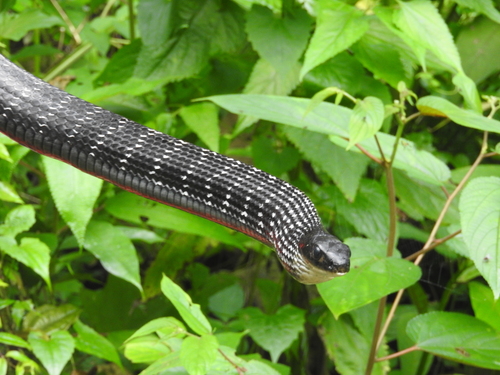
Tropidolaemus wagleri, more commonly known as Wagler's pit viper, is a species of venomous snake, a pit viper in the subfamily Crotalinae of the family Viperidae. The species is endemic to Southeast Asia. There are no subspecies that are recognized as being valid. It is sometimes referred to as the temple viper because of its abundance around the Temple of the Azure Cloud in Malaysia.

The specific name, wagleri, is in honour of German herpetologist Johann Georg Wagler. The Wagler's pit viper is sexually dimorphic: the females grow to approximately 1 m (39+1⁄4 in) in total length (including tail), their bodies being black with yellow stripes. Males, on the other hand, typically do not exceed 75 cm (29+1⁄2 in). Males have large triangular-shaped heads, with relatively thin green bodies. They are almost entirely arboreal, and their tails are prehensile to aid in climbing.

They are found in a wide variety of colors and patterns, often referred to as "phases". In the past, some researchers classified the different phases as subspecies. The phases vary greatly from having a black or brown coloration as a base, with orange and yellow banding, to others having... Wikipedia →

Global Distribution

Parks Where Found

# Park Country Daily sighting probability
1 Gunung Leuser National Park 🇮🇩 Indonesia
~70%
2 Khao Sok National Park 🇹🇭 Thailand
~50%
3 Taman Negara National Park 🇲🇾 Malaysia
~30%

Cities Where Found

# City Country Daily sighting probability
1 Singapore 🇸🇬 Singapore
~30%
2 Kuala Lumpur 🇲🇾 Malaysia
~10%

Zoos & Centres Where Found

# Zoo / Centre Country
1 Los Angeles Zoo 🇺🇸 United States In captivity
2 Jacksonville Zoo and Gardens 🇺🇸 United States In captivity
3 National Zoo of Malaysia 🇲🇾 Malaysia In captivity
4 Fort Worth Zoo 🇺🇸 United States In captivity
5 Gembira Loka Zoo 🇮🇩 Indonesia In captivity
6 Siam Serpentarium 🇹🇭 Thailand In captivity
7 Entopia 🇲🇾 Malaysia In captivity
8 BXSea Aquarium 🇮🇩 Indonesia In captivity

Closest Relatives at Kuala Lumpur

No species of the same family or order lives in Kuala Lumpur, so these are its closest relatives here: other reptiles.

Before you go

What are the chances of seeing a Wagler's Pit Viper in Kuala Lumpur?

With luck

About 10% of wildlife watchers report a Wagler's Pit Viper sighting in Kuala Lumpur on a given day, based on 26 verified sightings from GBIF citizen-science data. It is the 13th most-seen of the 39 reptiles we can rate there. Over three days the chance rises to about 30%, and over a week to about 60%, if each day is a fresh chance.

When is the best time to see a Wagler's Pit Viper in Kuala Lumpur?

June and August–September

In those months about 20% of wildlife watchers report a Wagler's Pit Viper in Kuala Lumpur on a given day, against under 5% in March, the lowest month.

What time of day is best to see a Wagler's Pit Viper?

Between 2 and 5 pm

Across all the parks we cover, that three-hour window holds the most Wagler's Pit Viper sightings with a recorded time, and about 8 in 10 of them come between 6 am and 6 pm: it is a daytime animal.

Is Kuala Lumpur the best place to see a Wagler's Pit Viper?

2nd of 2

Of the 2 cities where we can rate Wagler's Pit Viper sightings, Kuala Lumpur ranks 2nd at about 10%. The best odds are in Singapore (Singapore, about 30%).

Where does the Wagler's Pit Viper sighting chance come from?

GBIF citizen-science records

It is estimated from how often the Wagler's Pit Viper is recorded against all the reptiles logged in Kuala Lumpur (26 verified sightings), calibrated against known sighting rates. Figures are rounded to the nearest 10% because citizen-science data supports honest approximations, not decimals, and months with records from fewer than five people show "—". How it works.

← Back to Kuala Lumpur