Socotra Cormorant

Socotra Cormorant

Phalacrocorax nigrogularis

LCNTVUVulnerableENCR
Daily sighting probability ~10% · With luck
at Kuwait City

In 3 days ~10% in a week ~30%

27 Verified sightings at Kuwait City
February Best month
☀️ Diurnal When it's spotted

About the Socotra Cormorant

The Socotra cormorant (Phalacrocorax nigrogularis) is a threatened species of cormorant that is endemic to the Persian Gulf and the south-east coast of the Arabian Peninsula. It is also sometimes known as the Socotran cormorant or, more rarely, as the Socotra shag. Individuals occasionally migrate as far west as the Red Sea coast. Despite its name, it was only confirmed in 2005 that it breeds on the Socotra islands in the Indian Ocean.

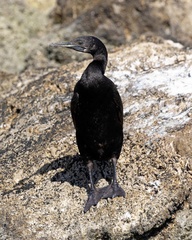
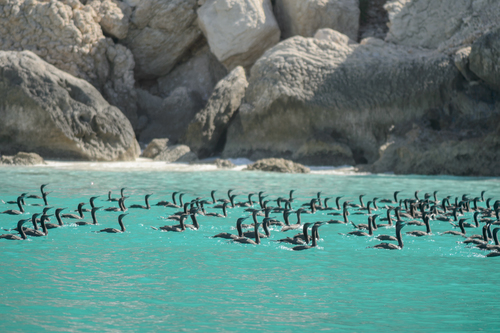
The Socotra cormorant is an almost entirely blackish bird with a total length of about 80 centimetres (31 in). In breeding condition, its forecrown has a purplish gloss and its upperparts have a slaty-green tinge, there are a few white plumes around the eye and neck and a few white streaks at the rump. Its legs and feet are black and its gular skin blackish. All these deviations from pure black are less marked outside the breeding season.

There is little information on this species' foraging or diet. Like all cormorants, it dives for its food. Older reports suggest that it can stay submerged for up to 3 minutes, which is high for a cormorant and suggests that it would be capable of deep diving. However, there are also reports of foraging in flocks, and this is usually seen in cormorants that feed in mid-water.

The birds are highly gregarious, with roosting flocks of 250,000 having been reported, and flocks of up to 25,000 at sea. Some authors, such as Paul Johnsgard, place this species, along with a number of other related cormorants, in a genus Leucocarbo.

Since 2000, this species has been listed as Vulnerable on the IUCN Red List, on the grounds of its small number of breeding localities and ongoing rapid decline. The decline is caused by coastal development, disturbance and marine pollution near its nesting colonies; in 2000 it was estimated that the world population was about 110,000 breeding pairs or 330,000–500,000 individual birds. The only protected nesting colony in the Persian Gulf is one of about 30,000 pairs on the Bahraini Hawar Islands off the coast of Qatar, and this is a Ramsar Convention listed site. Of the remaining 13 colonies (9 different locations), the Hawar colony is the largest. In the northern part of its range alone, about 12 colonies are known to have disappeared since the 1960s. The birds may also be affected by oil pollution at sea. Wikipedia →
Global Distribution

Parks Where Found

# Park Country Daily sighting probability

More parks will be added in future updates.

Cities Where Found

# City Country Daily sighting probability
1 Manama 🇧🇭 Bahrain
~10%
2 Abu Dhabi 🇦🇪 United Arab Emirates
~10%
3 Dubai 🇦🇪 United Arab Emirates
~10%
4 Kuwait City 🇰🇼 Kuwait
~10%
5 Doha 🇶🇦 Qatar
<5%

Zoos & Centres Where Found

# Zoo / Centre Country
1 African Village 🇦🇪 United Arab Emirates In captivity
2 مركز كلباء للطيور الجارحة 🇦🇪 United Arab Emirates In captivity

Before you go

What are the chances of seeing a Socotra Cormorant in Kuwait City?

With luck

About 10% of wildlife watchers report a Socotra Cormorant sighting in Kuwait City on a given day, based on 27 verified sightings from GBIF citizen-science data. It is the 91st most-seen of the 157 birds we can rate there. Over three days the chance rises to about 10%, and over a week to about 30%, if each day is a fresh chance.

When is the best time to see a Socotra Cormorant in Kuwait City?

November to February

In those months about 10% of wildlife watchers report a Socotra Cormorant in Kuwait City on a given day, against under 5% in March to October, the lowest months.

What time of day is best to see a Socotra Cormorant?

Between 7 and 10 am

Across all the parks we cover, that three-hour window holds the most Socotra Cormorant sightings with a recorded time, and about 9 in 10 of them come between 6 am and 6 pm: it is a daytime animal.

Is Kuwait City the best place to see a Socotra Cormorant?

Among the best

Of the 5 cities where we can rate Socotra Cormorant sightings, Kuwait City ranks 4th at about 10%, level with the leaders once rounded. The best odds are in Manama (Bahrain, about 10%), Abu Dhabi (United Arab Emirates, about 10%) and Dubai (United Arab Emirates, about 10%).

Where does the Socotra Cormorant sighting chance come from?

GBIF citizen-science records

It is estimated from how often the Socotra Cormorant is recorded against all the birds logged in Kuwait City (27 verified sightings), calibrated against known sighting rates. Figures are rounded to the nearest 10% because citizen-science data supports honest approximations, not decimals, and months with records from fewer than five people show "—". How it works.

← Back to Kuwait City