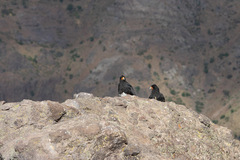
Mountain Caracara

Mountain Caracara

Phalcoboenus megalopterus

LCLeast ConcernNTVUENCR
Daily sighting probability ~50% · Likely
at La Paz

In 3 days ~90% in a week >90%

194 Verified sightings at La Paz
377 In 1 park From 2019 to 2026
March Best month
☀️ Diurnal When it's spotted

About the Mountain Caracara

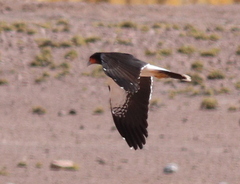
The mountain caracara (Daptrius megalopterus), (Spanish: corequenque) is a species of bird of prey in the family Falconidae. It is found in puna and páramo in the Andes, ranging from northern Ecuador, through Peru and Bolivia, to northern Argentina and Chile. It is generally uncommon to fairly common. It resembles the closely related carunculated caracara and white-throated caracara, but unlike those species, its chest is uniform black. Juveniles are far less distinctive than the red-faced pied adults, being overall brown with dull pinkish-grey facial skin.

The mountain caracara was formally described and illustrated in 1834 by the Prussian naturalist Franz Meyen under the binomial name Aquila megaloptera based on specimens collect in the Cordillera of Chile. The specific epithet combines the Ancient Greek μεγαλως/megalōs meaning "exceedingly" with -πτερος/-pteros meaning "-winged". The species is monotypic: no subspecies are recognised. The mountain caracara was formerly placed in the genus Phalcoboenus. Molecular genetic studies found that the genus Milvago was polyphyletic with the chimango caracara sister to the genus Phalcoboenus and the yellow-headed caracara sister...

Wikipedia →

Sounds

Call0:04

Peru · 2016

© Dries Van de Loock · XC682112 · CC BY-NC-SA 4.0

Begging call1:20

Bolivia · 2021

© Dante Buzzetti · XC683251 · CC BY-NC-SA 4.0

Call0:20

Bolivia · 2015

© Ross Gallardy · XC296377 · CC BY-NC-SA 4.0

Global Distribution

Parks Where Found

# Park Country Daily sighting probability
1 Lauca National Park 🇨🇱 Chile
~40%

More parks will be added in future updates.

Cities Where Found

# City Country Daily sighting probability
1 La Paz 🇧🇴 Bolivia
~50%
2 Cochabamba 🇧🇴 Bolivia
<5%

Zoos & Centres Where Found

# Zoo / Centre Country
1 Pairi Daiza 🇧🇪 Belgium In captivity
2 Tierpark Berlin 🇩🇪 Germany In captivity
3 Bioparque Municipal Vesty Pakos 🇧🇴 Bolivia In captivity
4 bioparco 🇮🇹 Italy In captivity
5 Camperdown Wildlife Centre 🇬🇧 United Kingdom In captivity
6 World of Birds Wildlife Sanctuary and Monkey Park 🇿🇦 South Africa In captivity
7 Ecozoológico San Martín 🇪🇨 Ecuador In captivity
8 Arequipa zoo 🇵🇪 Peru In captivity
9 Zoológico de Oruro 🇧🇴 Bolivia In captivity
10 Zoologischer Garten Hof 🇩🇪 Germany In captivity
11 Agroflori Parque de las Aves 🇧🇴 Bolivia In captivity
12 Gauntlet Birds of Prey 🇬🇧 United Kingdom In captivity
13 Greifvogelpark Buchs 🇨🇭 Switzerland In captivity

Before you go

What are the chances of seeing a Mountain Caracara in La Paz?

Likely

About 50% of wildlife watchers report a Mountain Caracara sighting in La Paz on a given day, based on 194 verified sightings from GBIF citizen-science data. It is the 12th most-seen of the 89 birds we can rate there. Over three days the chance rises to about 90%, and over a week to over 90%, if each day is a fresh chance.

When is the best time to see a Mountain Caracara in La Paz?

March and June

In those months about 70% of wildlife watchers report a Mountain Caracara in La Paz on a given day, against about 40% in July–August and December–February, the lowest months.

What time of day is best to see a Mountain Caracara?

Between 9 am and noon

Across all the parks we cover, that three-hour window holds the most Mountain Caracara sightings with a recorded time, and about 9 in 10 of them come between 6 am and 6 pm: it is a daytime animal.

Is La Paz the best place to see a Mountain Caracara?

Yes

Of the 2 cities where we can rate Mountain Caracara sightings, La Paz has the highest daily chance: about 50%. Next come Cochabamba (Bolivia, under 5%).

Where does the Mountain Caracara sighting chance come from?

GBIF citizen-science records

It is estimated from how often the Mountain Caracara is recorded against all the birds logged in La Paz (194 verified sightings), calibrated against known sighting rates. Figures are rounded to the nearest 10% because citizen-science data supports honest approximations, not decimals, and months with records from fewer than five people show "—". How it works.

← Back to La Paz