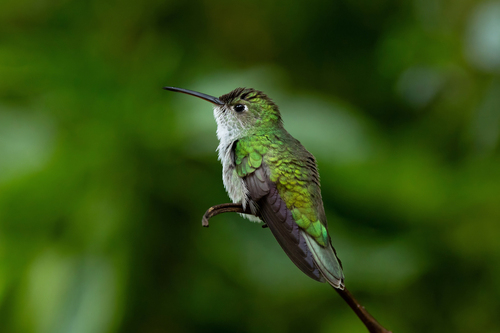
Giant Hummingbird

Giant Hummingbird

Patagona gigas

Silhouette: Chrissy McClarren & Andy Reago (original photograph) · PhyloPic

LCLeast ConcernNTVUENCR
Daily sighting probability ~60% · Likely
at La Paz

In 3 days ~90% in a week >90%

202 Verified sightings at La Paz
133 In 1 park From 2019 to 2026
October Best month
☀️ Diurnal When it's spotted

About the Giant Hummingbird

The southern giant hummingbird (Patagona gigas) is one of two species in the genus Patagona and the second largest hummingbird species, after its close relative the northern giant hummingbird. It and the sympatric northern giant hummingbird (P. peruviana) were once considered the same species, i.e., the giant hummingbird, though some researchers have already classified them as different species or subspecies in the past. Genomic analysis supports the separation of the two species which shows that they diverged between 2.1 and 3.4 million years ago, in the late Pliocene. Williamson and colleagues attributed the binomial name Patagona chaski to the northern giant hummingbird in 2024, but this taxon was already described as Patagona peruviana by Adolphe Boucard in 1893, so P. chaski is a junior synonym of P. peruviana.

Its mass is in the range of 17–31 g (0.60–1.09 oz), making it approximately twice as heavy as the next largest hummingbird. It has a wingspan of 21.5 cm (8.5 in), with a body length of 23 cm (9.1 in). The two subspecies are visually distinguishable. P. g. peruviana is yellowish brown overall and has white on the chin and throat, where P... Wikipedia →

Sounds

Call0:05

Ecuador · 2024

© Manuel Sanchez-Nivicela · XC859171 · CC BY-NC-ND 4.0

Recording0:06

Ecuador · 2022

© Lorena Córdova · XC707798 · CC BY-NC-SA 4.0

Song0:08

Chile · 2016

© Cristian Pinto · XC382312 · CC BY-NC-SA 4.0

Global Distribution

Parks Where Found

# Park Country Daily sighting probability
1 Lauca National Park 🇨🇱 Chile
~20%

More parks will be added in future updates.

Cities Where Found

# City Country Daily sighting probability
1 La Paz 🇧🇴 Bolivia
~60%
2 Cochabamba 🇧🇴 Bolivia
<5%
3 Arequipa 🇵🇪 Peru
<5%
4 Quito 🇪🇨 Ecuador
<5%
5 Santiago 🇨🇱 Chile
<5%

Zoos & Centres Where Found

# Zoo / Centre Country
1 Bioparque Municipal Vesty Pakos 🇧🇴 Bolivia In captivity

Before you go

What are the chances of seeing a Giant Hummingbird in La Paz?

Likely

About 60% of wildlife watchers report a Giant Hummingbird sighting in La Paz on a given day, based on 202 verified sightings from GBIF citizen-science data. It is the 6th most-seen of the 88 birds we can rate there. Over three days the chance rises to about 90%, and over a week to over 90%, if each day is a fresh chance.

When is the best time to see a Giant Hummingbird in La Paz?

October

In that month about 80% of wildlife watchers report a Giant Hummingbird in La Paz on a given day, against about 40% in March, the lowest month.

What time of day is best to see a Giant Hummingbird?

Between 10 am and 1 pm

Across all the parks we cover, that three-hour window holds the most Giant Hummingbird sightings with a recorded time, and about 9 in 10 of them come between 6 am and 6 pm: it is a daytime animal.

Is La Paz the best place to see a Giant Hummingbird?

Yes

Of the 5 cities where we can rate Giant Hummingbird sightings, La Paz has the highest daily chance: about 60%. Next come Cochabamba (Bolivia, under 5%) and Arequipa (Peru, under 5%).

Which relatives of the Giant Hummingbird live in La Paz?

Same family: Trochilidae

The closest relatives of the Giant Hummingbird that you can see in La Paz (family Trochilidae, Hummingbirds) are Sparkling Violetear (about 60%) and Red-tailed Comet (about 40%), with each one's daily chance of a sighting.

Where does the Giant Hummingbird sighting chance come from?

GBIF citizen-science records

It is estimated from how often the Giant Hummingbird is recorded against all the birds logged in La Paz (202 verified sightings), calibrated against known sighting rates. Figures are rounded to the nearest 10% because citizen-science data supports honest approximations, not decimals, and months with records from fewer than five people show "—". How it works.

← Back to La Paz