Sind Sparrow

Sind Sparrow

Passer pyrrhonotus

LCLeast ConcernNTVUENCR
Daily sighting probability ~10% · With luck
at Lahore

In 3 days ~20% in a week ~40%

6 Verified sightings at Lahore
October Best month

About the Sind Sparrow

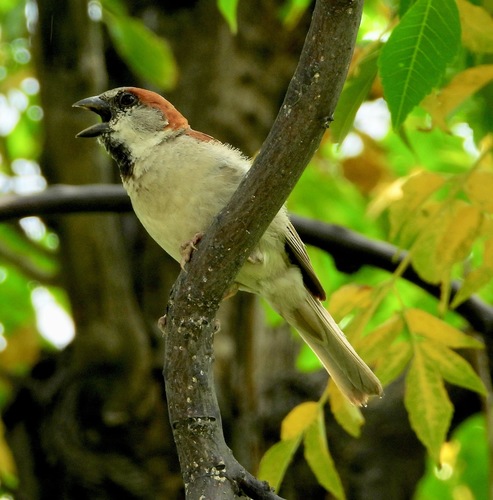
The Sind sparrow (Passer pyrrhonotus) is a passerine bird of the sparrow family, Passeridae, found around the Indus valley region in South Asia. Its name refers to the province of Sindh, and it is also known as the jungle, Sind jungle, or rufous-backed sparrow. Very similar to the related house sparrow, it is smaller and has distinguishing plumage features. As in the house sparrow, the male has brighter plumage than female and young birds, including black markings and a grey crown. Distinctively, the male has a chestnut stripe running down its head behind the eye, and the female has a darker head than other sparrow species. Its main vocalisations are soft chirping calls that are extended into longer songs with other sounds interspersed by breeding males. Historically, this species was thought to be very closely related to the house sparrow, but its closest evolutionary affinities may lie elsewhere. The species was discovered around 1840, but went undetected for several decades afterwards.

Within its Indus valley breeding range in Pakistan and western India, the Sind sparrow is patchily distributed in riverine and wetland habitats with thorny scrub and tall grass. During the non-breeding season, some birds enter drier habitats as they disperse short distances from their breeding habitat, or migrate into western Pakistan and the extreme east of Iran. Since this species is fairly common and expanding its range, it is assessed as least concern on the IUCN Red List. The Sind sparrow is social while feeding and gathers in small groups both while breeding and during winter dispersal. It feeds mostly on seeds and less often on insects, foraging close to the ground. Nests are made in the branches of thorny trees, and are untidy globular masses constructed from grass or other plant matter and lined with softer material. Both sexes are involved in building the nest and caring for the young, and usually raise two clutches of three to five young each breeding season. Wikipedia →
Sounds

Subsong0:17

India · 2026

© Ding Li Yong · XC1088309 · CC BY-NC-ND 4.0

Song0:47

India · 2025

© Peter Boesman · XC1030723 · CC BY-NC-ND 4.0

Call0:26

India · 2019

© Raphaël Jordan · XC461590 · CC BY-NC-SA 4.0

Global Distribution

Parks Where Found

# Park Country Daily sighting probability

More parks will be added in future updates.

Cities Where Found

# City Country Daily sighting probability
1 Lahore 🇵🇰 Pakistan
~10%
2 Chandigarh 🇮🇳 India
<5%

Before you go

What are the chances of seeing a Sind Sparrow in Lahore?

With luck

About 10% of wildlife watchers report a Sind Sparrow sighting in Lahore on a given day, based on 6 verified sightings from GBIF citizen-science data. It is the 50th most-seen of the 72 birds we can rate there. Over three days the chance rises to about 20%, and over a week to about 40%, if each day is a fresh chance.

When is the best time to see a Sind Sparrow in Lahore?

October

In that month about 30% of wildlife watchers report a Sind Sparrow in Lahore on a given day, against under 5% in January–May, August–September and November, the lowest months. That is one of Lahore's driest months, with about 10 mm of rain against 160 mm in July. June and July have too few records to rate.

Is Lahore the best place to see a Sind Sparrow?

Yes

Of the 2 cities where we can rate Sind Sparrow sightings, Lahore has the highest daily chance: about 10%. Next come Chandigarh (India, under 5%).

Where does the Sind Sparrow sighting chance come from?

GBIF citizen-science records

It is estimated from how often the Sind Sparrow is recorded against all the birds logged in Lahore (6 verified sightings), calibrated against known sighting rates. Figures are rounded to the nearest 10% because citizen-science data supports honest approximations, not decimals, and months with records from fewer than five people show "—". How it works.

← Back to Lahore

