About the Spotted Lanternfly
The spotted lanternfly (Lycorma delicatula) is a species of planthopper indigenous to parts of China and Vietnam. It was accidentally introduced into South Korea and has spread invasively to Japan, 21 U.S. states, and Windsor, Ontario in Canada, (where it is often referred to by the acronym "SLF") and parts of Eastern Europe including Moldova. Its preferred host is the also invasive tree of heaven (Ailanthus altissima), but it also feeds on other trees, and on crops including soybean, grapes, stone fruits, and the Malus (apple) genus. In its native habitat, L. delicatula populations are regulated by parasitic wasps.
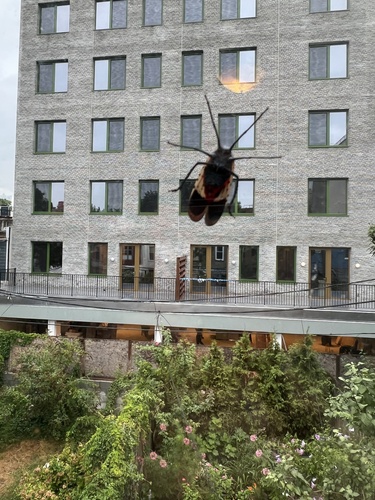
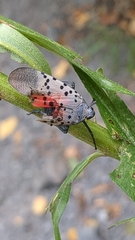
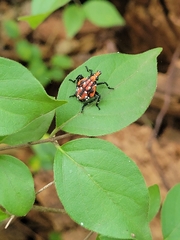
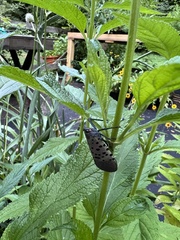
The spotted lanternfly's life cycle is often centered on its preferred host, Ailanthus altissima, but L. delicatula can associate with more than 173 plants. Early life stages (instars) of the spotted lanternfly are characterized by spotted black and white nymphs that develop a red pigmentation and wings as they mature. Early life instars have a large host range that narrows with maturation. Adult spotted lanternflies have a black head, grey fore wings, and red hind wings. Adults do not have any specialized feeding associations with herbaceous plants but cause extensive damage to crops and ornamental plants. The piercing wounds caused by their mouthparts and the honeydew waste they excrete are harmful to the health of host plants. They feed on the sap of host plants, including the tree of heaven, which is also invasive in the United States. The spotted lanternfly does not pose direct danger to humans through biting or stinging. Spotted lanternflies lay egg masses containing 30–50 eggs, often covered with a grayish mud-like coating.
The species was introduced into South Korea in 2006 and Japan in 2009, where it has since been considered a pest. In September 2014, L. delicatula was first recorded in the United States, and as of 2022, it is considered an invasive species in much of the Northeastern United States, rapidly spreading south and west. L. delicatula's egg masses are the primary vector of spread, with Ailanthus altissima populations seen as a risk factor for further infestation globally. Ongoing pest control efforts have sought to limit population growth, due to the threat L. delicatula poses to global agricultural industries. Parts of the United States have undergone massive pest control efforts to cull the spotted lanternfly's population. However, this process indirectly harms other species. Wikipedia →