About the Yellow-footed Gull
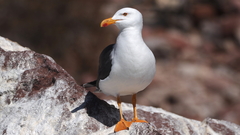
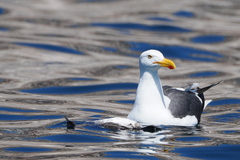
The yellow-footed gull (Larus livens) is a large gull, closely related to the western gull and thought to be a subspecies until the 1960s. It is endemic to the Gulf of California. Adults are similar in appearance to the western gull with a white head, dark, slate-colored back and wings, and a thick yellow bill. Their legs are yellow, though first winter birds do display pink legs like those of the western gull. It attains full plumage at three years of age.
This species is tied with slaty-backed gull for the world's fourth-largest gull species and is one of the largest gulls in the world, being slightly larger than the western gull. It measures 53 to 72 cm (21 to 28 in) in length and spans 140 to 160 cm (55 to 63 in) across the wings. The body mass of this species can vary from 930 to 1,500 g (2.05 to 3.31 lb). Among standard measurements, the wing chord is 40 to 46 cm (16 to 18 in), the bill is 5.0 to 6.2 cm (2.0 to 2.4 in) and the tarsus is 5.9 to 7.5 cm (2.3 to 3.0 in).
Yellow-footed gulls are native to the Gulf of California in Mexico. Most are non-migratory, but an increasing number have been traveling to California's Salton Sea... Wikipedia →