Painted Tody-Flycatcher

Painted Tody-Flycatcher

Todirostrum pictum

Silhouette: Emily Willoughby · PhyloPic

LCLeast ConcernNTVUENCR
Daily sighting probability <5% · Rare
at Manaus

In 3 days ~10% in a week ~20%

10 Verified sightings at Manaus
12 In 1 park From 2019 to 2026
September Best month
☀️ Diurnal When it's spotted

About the Painted Tody-Flycatcher

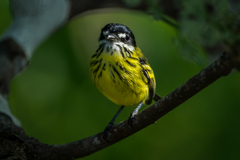
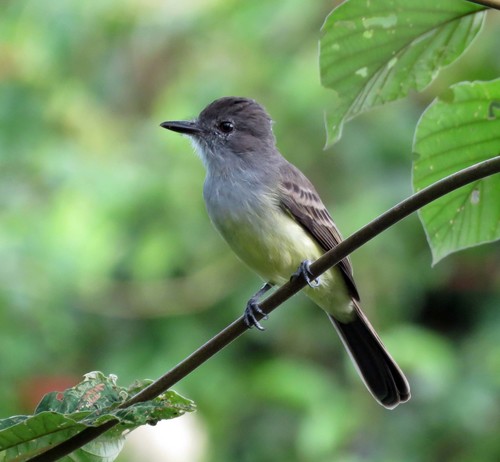
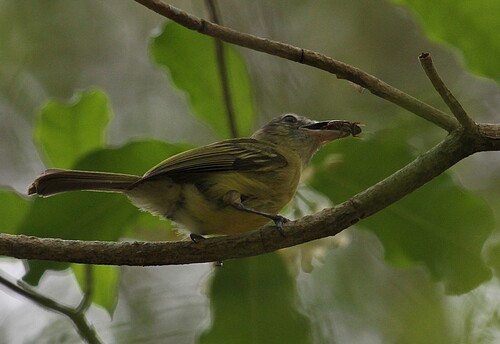
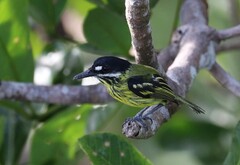
The painted tody-flycatcher (Todirostrum pictum) is a species of bird in the family Tyrannidae, the tyrant flycatchers. It is found in Brazil, French Guiana, Guyana, Suriname, Venezuela, and possibly Colombia. The painted tody-flycatcher was originally described in 1897 as a full species with its current binomial Todirostrum pictum. Some mid-twentieth century authors considered it a subspecies of the yellow-browed tody-flycatcher (T. chrysocrotaphum) but by the 1970s it had regained is status as a full species. Several authors treat the painted, yellow-browed, and black-headed tody-flycatcher (T. nigriceps) as a superspecies.

The painted tody-flycatcher is monotypic. The painted tody-flycatcher is 9 to 10.2 cm (3.5 to 4.0 in) long and weighs 6 to 8 g (0.21 to 0.28 oz). The sexes are alike. Adults have a mostly black head with a white spot above the lores and a long white "moustache". A narrow yellow band separates their nape from their olive back, rump, and uppertail coverts. Their wings are black with yellow edges on the flight feathers and the edges and tips of the coverts; the last show as two wing bars. Their tail is black with olive... Wikipedia →

Sounds

Call0:31

French Guiana · 2025

© Paul Lenrumé · XC998452 · CC BY-NC-SA 4.0

Song0:12

Brazil · 2019

© JAYRSON ARAUJO DE OLIVEIRA · XC493992 · CC BY-NC-SA 4.0

Chamado0:15

Brazil · 2017

© Caio Brito · XC428092 · CC BY-NC-SA 4.0

Global Distribution

Parks Where Found

# Park Country Daily sighting probability
1 Brownsberg Nature Park 🇸🇷 Suriname
<5%

More parks will be added in future updates.

Cities Where Found

# City Country Daily sighting probability
1 Manaus 🇧🇷 Brazil
<5%

Before you go

What are the chances of seeing a Painted Tody-Flycatcher in Manaus?

Rare

Under 5% of wildlife watchers report a Painted Tody-Flycatcher sighting in Manaus on a given day, based on 10 verified sightings from GBIF citizen-science data. It is the 87th most-seen of the 116 birds we can rate there. Over three days the chance rises to about 10%, and over a week to about 20%, if each day is a fresh chance.

When is the best time to see a Painted Tody-Flycatcher in Manaus?

April and September

In those months about 10% of wildlife watchers report a Painted Tody-Flycatcher in Manaus on a given day, against under 5% in May–August and October–March, the lowest months.

What time of day is best to see a Painted Tody-Flycatcher?

Between 7 and 10 am

Across all the parks we cover, that three-hour window holds the most Painted Tody-Flycatcher sightings with a recorded time, and about 9 in 10 of them come between 6 am and 6 pm: it is a daytime animal.

Where else can you see a Painted Tody-Flycatcher?

Only Manaus, in our data

Manaus is the only city on Wallace's Line with enough records to rate Painted Tody-Flycatcher sightings: under 5% of wildlife watchers there report one on a given day.

Where does the Painted Tody-Flycatcher sighting chance come from?

GBIF citizen-science records

It is estimated from how often the Painted Tody-Flycatcher is recorded against all the birds logged in Manaus (10 verified sightings), calibrated against known sighting rates. Figures are rounded to the nearest 10% because citizen-science data supports honest approximations, not decimals, and months with records from fewer than five people show "—". How it works.

← Back to Manaus