Guaiabero

Guaiabero

Bolbopsittacus lunulatus

LCLeast ConcernNTVUENCR
Daily sighting probability <5% · Rare
at Manila

In 3 days ~10% in a week ~20%

126 Verified sightings at Manila
March Best month
☀️ Diurnal When it's spotted

About the Guaiabero

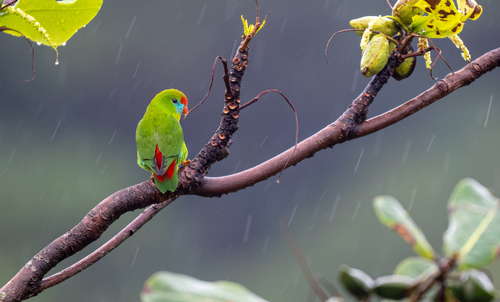
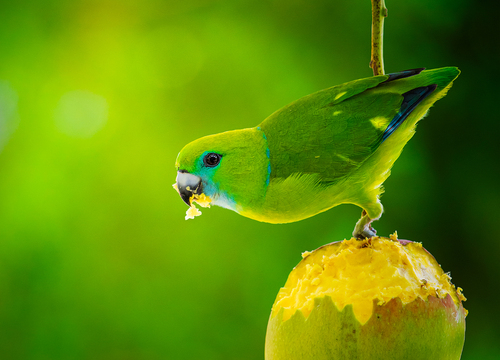
The guaiabero (Bolbopsittacus lunulatus) is a species of parrot in the family Psittaculidae, belonging to the monotypic genus Bolbopsittacus and closely related to the lovebirds and hanging parrots. It is endemic to the Philippines and locally known as bubutok. Its common name is derived from its reputation for eating guavas.

Measuring around 15 cm (5.9 in) in length, it is a smallish, stout parrot with a large bill and stubby tail. The sexes differ in plumage. The adult male is green overall, with more yellowish underparts and a pale blue face and collar and wing primaries. The rump is yellow-green. The bill is grey-blue and with a darker tip, and the eyes dark brown. The adult female is also greenish, with a yellow collar and less blue on the face. It has black crescent markings on the nape and rump. Its bill is paler grey.

The guaiabero was first described as Psittacus lunulatus by Tyrolean naturalist Giovanni Antonio Scopoli in 1786. The only member of its genus, it is distinctive. Four subspecies are recognized: B l. lunulatus— Found on Luzon

B l. intermedius — Found on Leyte and Panaon Island; darker with a more distinctive... Wikipedia →
Global Distribution

Parks Where Found

# Park Country Daily sighting probability

More parks will be added in future updates.

Cities Where Found

# City Country Daily sighting probability
1 Davao City 🇵🇭 Philippines
~20%
2 Manila 🇵🇭 Philippines
<5%

Before you go

What are the chances of seeing a Guaiabero in Manila?

Rare

Under 5% of wildlife watchers report a Guaiabero sighting in Manila on a given day, based on 126 verified sightings from GBIF citizen-science data. It is the 84th most-seen of the 191 birds we can rate there. Over three days the chance rises to about 10%, and over a week to about 20%, if each day is a fresh chance.

When is the best time to see a Guaiabero in Manila?

March–April and September

In those months about 10% of wildlife watchers report a Guaiabero in Manila on a given day, against under 5% in May–August and October–February, the lowest months.

What time of day is best to see a Guaiabero?

Between 6 and 9 am

Across all the parks we cover, that three-hour window holds the most Guaiabero sightings with a recorded time, and about 8 in 10 of them come between 6 am and 6 pm: it is a daytime animal.

Is Manila the best place to see a Guaiabero?

2nd of 2

Of the 2 cities where we can rate Guaiabero sightings, Manila ranks 2nd at under 5%. The best odds are in Davao City (Philippines, about 20%).

Which relatives of the Guaiabero live in Manila?

Same family: Psittacidae

The closest relatives of the Guaiabero that you can see in Manila (family Psittacidae, New World and African Parrots) are Philippine Hanging-Parrot (about 20%) and Rose-ringed Parakeet (about 10%), with each one's daily chance of a sighting.

Where does the Guaiabero sighting chance come from?

GBIF citizen-science records

It is estimated from how often the Guaiabero is recorded against all the birds logged in Manila (126 verified sightings), calibrated against known sighting rates. Figures are rounded to the nearest 10% because citizen-science data supports honest approximations, not decimals, and months with records from fewer than five people show "—". How it works.

← Back to Manila