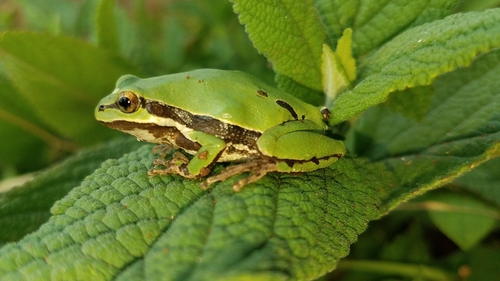
Barking Frog

Barking Frog

Craugastor augusti

Silhouette: Jose Carlos Arenas-Monroy · PhyloPic

LCLeast ConcernNTVUENCR
Daily sighting probability ~10% · With luck
at Mexico City

In 3 days ~20% in a week ~30%

46 Verified sightings at Mexico City
6 In 1 park From 2019 to 2026
August Best month
☀️🌙 Day & Night When it's spotted

About the Barking Frog

Craugastor augusti is a species of frog in the family Craugastoridae found in Mexico and the southern United States. It is known by various common names but most commonly as the barking frog (also common robber frog, cliff frog). The nominal species likely includes more than one species, sometimes described as subspecies such as the common barking frog (Craugastor augusti augusti), western barking frog (Craugastor augusti cactorum), and eastern barking frog (Craugastor augusti latrans). The epithet augusti is in honor of renowned French zoologist Auguste Duméril.

It is called the barking frog because its call sounds like the barking of a small dog, although vocalizations vary by area. It is an abundant species in Mexico but apparently rare in the United States. However, they are very difficult to detect unless they are calling, which only occurs during few nights after rains.

Adult Craugastor augusti measure 47–94 mm (1.9–3.7 in). They have a characteristic fold of skin across the back of the head as well as well-developed tubercles on their feet. Colouration is sexually dimorphic. The natural habitats of Craugastor augusti are shrublands... Wikipedia →

Sounds

Advertisement call0:17

United States · 2013

© Chris Harrison · XC890250 · CC BY-NC-SA 4.0

Recording1:00

United States · 2018

Cecelia Alexander · iNaturalist · CC0

Recording0:47

United States · 2018

Patrick Alexander · iNaturalist · CC0

Global Distribution

Parks Where Found

# Park Country Daily sighting probability
1 Cumbres de Monterrey National Park 🇲🇽 Mexico
<5%

More parks will be added in future updates.

Cities Where Found

# City Country Daily sighting probability
1 Mexico City 🇲🇽 México
~10%

Before you go

What are the chances of seeing a Barking Frog in Mexico City?

With luck

About 10% of wildlife watchers report a Barking Frog sighting in Mexico City on a given day, based on 46 verified sightings from GBIF citizen-science data. It is the 5th most-seen of the 10 amphibians we can rate there. Over three days the chance rises to about 20%, and over a week to about 30%, if each day is a fresh chance.

When is the best time to see a Barking Frog in Mexico City?

June to October

In those months about 10% of wildlife watchers report a Barking Frog in Mexico City on a given day, against under 5% in November to May, the lowest months. Those are among Mexico City's wettest months, with about 130 mm of rain a month against 5 mm in December.

What time of day is best to see a Barking Frog?

Between 10 am and 1 pm

Across all the parks we cover, that three-hour window holds the most Barking Frog sightings with a recorded time, and about 6 in 10 of them come between 6 am and 6 pm: it is seen both by day and at night.

Where else can you see a Barking Frog?

Only Mexico City, in our data

Mexico City is the only city on Wallace's Line with enough records to rate Barking Frog sightings: about 10% of wildlife watchers there report one on a given day.

Which relatives of the Barking Frog live in Mexico City?

Same order: Anura

The closest relatives of the Barking Frog that you can see in Mexico City (order Anura, Frogs and Toads) are Montezuma Leopard Frog (about 10%), Canyon Tree Frog (about 10%) and Mountain Treefrog (about 10%), with each one's daily chance of a sighting.

Where does the Barking Frog sighting chance come from?

GBIF citizen-science records

It is estimated from how often the Barking Frog is recorded against all the amphibians logged in Mexico City (46 verified sightings), calibrated against known sighting rates. Figures are rounded to the nearest 10% because citizen-science data supports honest approximations, not decimals, and months with records from fewer than five people show "—". How it works.

← Back to Mexico City