



Long-tongued Bat

Long-tongued Bat

Choeronycteris mexicana

Silhouette: Roberto Díaz Sibaja · PhyloPic

LCNTNear ThreatenedVUENCR
Daily sighting probability ~10% · With luck
at Mexico City

In 3 days ~20% in a week ~30%

47 Verified sightings at Mexico City
April Best month
☀️🌙 Day & Night When it's spotted

About the Long-tongued Bat

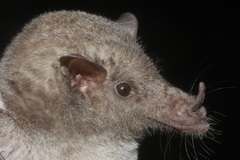
The Mexican long-tongued bat (Choeronycteris mexicana) is a species of bat in the family Phyllostomidae. It is the only species within the genus Choeronycteris. It is found in El Salvador, Guatemala, Honduras, Mexico, and the United States.

The genus name Choeronycteris is derived from the Greek words choiros (pig) and nykteris (bat). The specific name mexicana correlates to its distribution. The Mexican long-tongued bat is medium in size in the family Phyllostomidae. Its pelage can be up to 7 mm long and is typically gray to brownish but can be paler on the shoulders. Wings are darker brownish gray with paler tips. The ears will also have the same coloration as the body and will vary in size. The tail is short. Body weight is 10-20 g, with a maximum of 25 g in pregnant females.

The species has a distinctly elongated snout tipped with a roughly 5 mm-long nose-leaf. The tongue is long, narrow and extendible, specialized for nectar feeding. It is covered with tiny hairlike papillae, which become more thorny towards the base of the tongue. The skull is up to 30 mm long, with the rostrum making up 40-50% of total length. Juveniles have 22 deciduous teeth... Wikipedia →

Global Distribution

Parks Where Found

# Park Country Daily sighting probability

More parks will be added in future updates.

Cities Where Found

# City Country Daily sighting probability
1 Mexico City 🇲🇽 México
~10%

Before you go

What are the chances of seeing a Long-tongued Bat in Mexico City?

With luck

About 10% of wildlife watchers report a Long-tongued Bat sighting in Mexico City on a given day, based on 47 verified sightings from GBIF citizen-science data. It is the 9th most-seen of the 19 mammals we can rate there. Over three days the chance rises to about 20%, and over a week to about 30%, if each day is a fresh chance.

When is the best time to see a Long-tongued Bat in Mexico City?

February, April–May, July and September–October

In those months about 10% of wildlife watchers report a Long-tongued Bat in Mexico City on a given day, against under 5% in March, June, August and November–January, the lowest months.

What time of day is best to see a Long-tongued Bat?

Between 8 and 11 pm

Across all the parks we cover, that three-hour window holds the most Long-tongued Bat sightings with a recorded time, and about half of them come between 6 pm and 6 am: it is seen both by day and at night.

Where else can you see a Long-tongued Bat?

Only Mexico City, in our data

Mexico City is the only city on Wallace's Line with enough records to rate Long-tongued Bat sightings: about 10% of wildlife watchers there report one on a given day.

Where does the Long-tongued Bat sighting chance come from?

GBIF citizen-science records

It is estimated from how often the Long-tongued Bat is recorded against all the mammals logged in Mexico City (47 verified sightings), calibrated against known sighting rates. Figures are rounded to the nearest 10% because citizen-science data supports honest approximations, not decimals, and months with records from fewer than five people show "—". How it works.

← Back to Mexico City