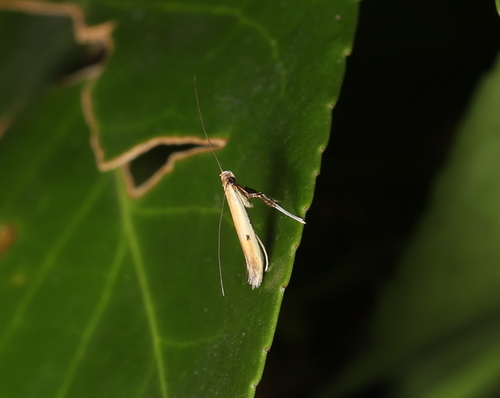


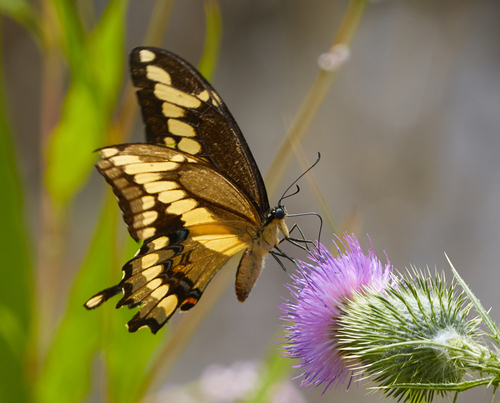

Chilocampyla dyariella

Chilocampyla dyariella

Chilocampyla dyariella

Silhouette: Kanako Bessho-Uehara · PhyloPic

Daily sighting probability <5% · Rare
at Miami

In 3 days ~10% in a week ~20%

23 Verified sightings at Miami
40 In all 2 parks From 2019 to 2026
December Best month
☀️ Diurnal When it's spotted

About the Chilocampyla dyariella

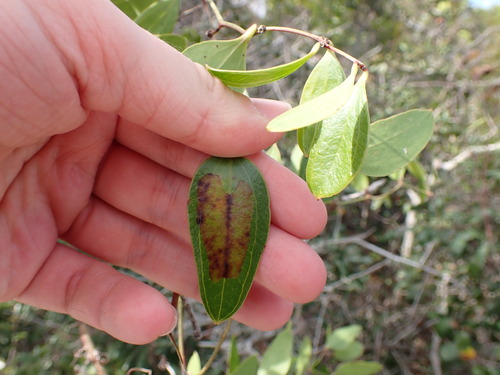
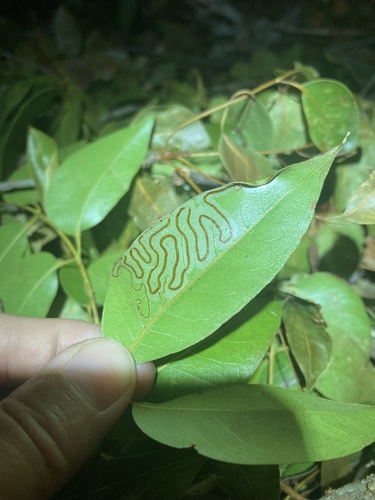
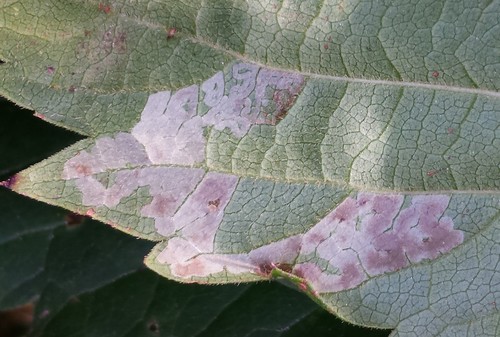
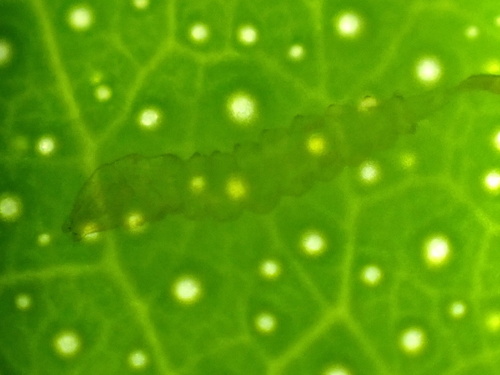
Chilocampyla dyariella is a moth of the family Gracillariidae. It is known from Florida, United States. The wingspan is 7-8.5 mm. The larvae feed on Eugenia species including Eugenia axillaris, Eugenia foetida, Eugenia garberi, Eugenia procera and Eugenia rhombea. They mine the leaves of their host plant. The mine has the form of a long narrow line along the edge of the leaf for about 25 mm and then turning inward suddenly broadening out in a large bladder-like blotch nearly covering the entire leaf. The upper and lower epidermis are separated and the leaf is inflated and yields to pressure like an air cushion. The mine shows whitish green on the underside, discoloured with purple on the upper side. The inside of the mine looks as if it is overgrown with a small, whitish pearly fungus. The larva is cylindrical, clear, transparent, with sparse white hairs and 14 legs. The head is light brown with darker reddish brown sutures and two black eyespots. When full grown, it leaves the mine, turns vivid wine red, and spins a dense, oval, yellowish grey cocoon in a slight fold on the leaf. The pupa is white at first. When mature the pupa assumes the coloration of the imago. Wikipedia →

Global Distribution

Parks Where Found

# Park Country Daily sighting probability
1 Everglades National Park 🇺🇸 United States
~10%
2 Big Cypress National Preserve 🇺🇸 United States
~10%

Cities Where Found

# City Country Daily sighting probability
1 Miami 🇺🇸 United States
<5%

Before you go

What are the chances of seeing a Chilocampyla dyariella in Miami?

Rare

Under 5% of wildlife watchers report a Chilocampyla dyariella sighting in Miami on a given day, based on 23 verified sightings from GBIF citizen-science data. It is the 366th most-seen of the 826 insects we can rate there. Over three days the chance rises to about 10%, and over a week to about 20%, if each day is a fresh chance.

When is the best time to see a Chilocampyla dyariella in Miami?

December

In that month about 10% of wildlife watchers report a Chilocampyla dyariella in Miami on a given day, against under 5% in January to November, the lowest months. That is one of Miami's driest months, with about 50 mm of rain against 190 mm in June.

What time of day is best to see a Chilocampyla dyariella?

Between noon and 3 pm

Across all the parks we cover, that three-hour window holds the most Chilocampyla dyariella sightings with a recorded time, and about 9 in 10 of them come between 6 am and 6 pm: it is a daytime animal.

Where else can you see a Chilocampyla dyariella?

Only Miami, in our data

Miami is the only city on Wallace's Line with enough records to rate Chilocampyla dyariella sightings: under 5% of wildlife watchers there report one on a given day.

Where does the Chilocampyla dyariella sighting chance come from?

GBIF citizen-science records

It is estimated from how often the Chilocampyla dyariella is recorded against all the insects logged in Miami (23 verified sightings), calibrated against known sighting rates. Figures are rounded to the nearest 10% because citizen-science data supports honest approximations, not decimals, and months with records from fewer than five people show "—". How it works.

← Back to Miami