Nathusius's pipistrelle

Nathusius's pipistrelle

Pipistrellus nathusii

Silhouette: Evgeniy Yakhontov · PhyloPic

LCLeast ConcernNTVUENCR
Daily sighting probability <5% · Rare
at Moscow

In 3 days ~10% in a week ~20%

12 Verified sightings at Moscow
August Best month
☀️🌙 Day & Night When it's spotted

About the Nathusius's pipistrelle

Nathusius' pipistrelle (Pipistrellus nathusii) is a small bat in the genus Pipistrellus. It is very similar to the common pipistrelle and has been overlooked in many areas until recently but it is widely distributed across Europe. It was described by two German naturalists, Alexander Keyserling and Johann Heinrich Blasius, and named by them after Hermann von Nathusius, in gratitude for his support of their research.

The length of the head and body is 46–55 mm and the wingspan is 220–250 mm. It has a forearm length of 32–40 mm and weighs about 6–15.5g. The fifth finger is longer than 43 mm. Its fur is medium-dark reddish-brown above, often with paler tips, and is pale brown below. The fur is longer and less uniformly colored compared to the common pipistrelle. It is also larger, with broader wings. The face, ears, wings, and tail are dark.

Nathusius' pipistrelle occurs from Western Europe eastward as far as the Ural Mountains, Turkey and the Caucasus. It is highly migratory with individuals from northern and eastern areas moving south-west for the winter. Preferred habitats are parkland and light woodland, often near water.

It is generally commoner... Wikipedia →

Sounds

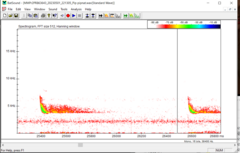
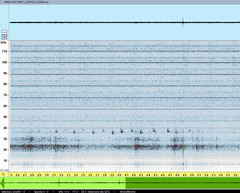
Recording0:31

Netherlands · 2026

Max G.W. Verheij · iNaturalist · CC0

Recording0:05

United Kingdom · 2026

© brook1951 · iNaturalist · CC BY-NC 4.0

Recording0:17

Estonia

© Lauri Lutsar · PlutoF platform reference · CC BY-NC 4.0

Global Distribution

Parks Where Found

# Park Country Daily sighting probability

More parks will be added in future updates.

Cities Where Found

# City Country Daily sighting probability
1 Moscow 🇷🇺 Russia
<5%

Before you go

What are the chances of seeing a Nathusius's pipistrelle in Moscow?

Rare

Under 5% of wildlife watchers report a Nathusius's pipistrelle sighting in Moscow on a given day, based on 12 verified sightings from GBIF citizen-science data. It is the 19th most-seen of the 25 mammals we can rate there. Over three days the chance rises to about 10%, and over a week to about 20%, if each day is a fresh chance.

When is the best time to see a Nathusius's pipistrelle in Moscow?

Any time of year

In every month with enough records, under 5% of wildlife watchers report a Nathusius's pipistrelle in Moscow on a given day, so our monthly data shows no clear season.

What time of day is best to see a Nathusius's pipistrelle?

Between 9 pm and midnight

Across all the parks we cover, that three-hour window holds the most Nathusius's pipistrelle sightings with a recorded time, and about 6 in 10 of them come between 6 pm and 6 am: it is seen both by day and at night.

Where else can you see a Nathusius's pipistrelle?

Only Moscow, in our data

Moscow is the only city on Wallace's Line with enough records to rate Nathusius's pipistrelle sightings: under 5% of wildlife watchers there report one on a given day.

Where does the Nathusius's pipistrelle sighting chance come from?

GBIF citizen-science records

It is estimated from how often the Nathusius's pipistrelle is recorded against all the mammals logged in Moscow (12 verified sightings), calibrated against known sighting rates. Figures are rounded to the nearest 10% because citizen-science data supports honest approximations, not decimals, and months with records from fewer than five people show "—". How it works.

← Back to Moscow