Forest Blood Sucker

Forest Blood Sucker

Monilesaurus rouxii

Silhouette: PhyloPic

LCLeast ConcernNTVUENCR
Daily sighting probability ~10% · With luck
at Mumbai

In 3 days ~30% in a week ~60%

26 Verified sightings at Mumbai
June Best month
☀️ Diurnal When it's spotted

About the Forest Blood Sucker

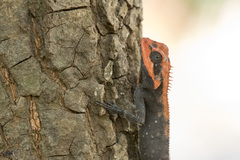
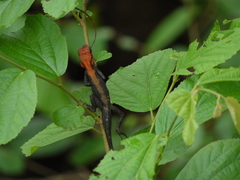
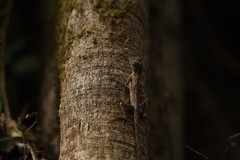
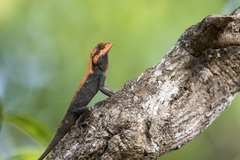
Monilesaurus rouxii, commonly known as Roux's forest lizard, Roux's forest calotes, or the forest blood sucker, is a species of arboreal, diurnal, agamid lizard, which is endemic to hills of peninsular India. In July 2018, it was proposed that the species should be transferred to the new genus Monilesaurus.

The specific name, rouxii, is in honor of Jean Louis Florent Polydore Roux, who was a French painter and naturalist. M. rouxii can attain a total length (including tail) of up to 30 cm (12 in), but 25 cm (9.8 in) is more common. Its body has an olive-brown color, with a lighter belly, a dark band along the side of the head on to the neck, and dark lines radiating from the eye. The limbs are slender, with elongated toes. Two small groups of spines adorn each side of the neck. In males, the upper part of the head, nape, and gular pouch become brick-red in the breeding season.

Monilesaurus rouxii is endemic to hills of peninsular India, including the Western Ghats from Surat Dangs till Palghat; and parts of the Eastern Ghats (Shevaroys, Yelagiri, Melagiri, and in Malkangiri, Araku, Devarakonda) and hills of Deccan plateau... Wikipedia →

Global Distribution

Parks Where Found

# Park Country Daily sighting probability

More parks will be added in future updates.

Cities Where Found

# City Country Daily sighting probability
1 Mumbai 🇮🇳 India
~10%

Zoos & Centres Where Found

# Zoo / Centre Country
1 Tula Exotarium 🇷🇺 Russia In captivity

Before you go

What are the chances of seeing a Forest Blood Sucker in Mumbai?

With luck

About 10% of wildlife watchers report a Forest Blood Sucker sighting in Mumbai on a given day, based on 26 verified sightings from GBIF citizen-science data. It is the 7th most-seen of the 23 reptiles we can rate there. Over three days the chance rises to about 30%, and over a week to about 60%, if each day is a fresh chance.

When is the best time to see a Forest Blood Sucker in Mumbai?

June

In that month about 30% of wildlife watchers report a Forest Blood Sucker in Mumbai on a given day, against under 5% in January–February, April and July, the lowest months. That is one of Mumbai's wettest months, with about 540 mm of rain against almost none in January.

What time of day is best to see a Forest Blood Sucker?

Between 6 and 9 am

Across all the parks we cover, that three-hour window holds the most Forest Blood Sucker sightings with a recorded time, and about 8 in 10 of them come between 6 am and 6 pm: it is a daytime animal.

Where else can you see a Forest Blood Sucker?

Only Mumbai, in our data

Mumbai is the only city on Wallace's Line with enough records to rate Forest Blood Sucker sightings: about 10% of wildlife watchers there report one on a given day.

Where does the Forest Blood Sucker sighting chance come from?

GBIF citizen-science records

It is estimated from how often the Forest Blood Sucker is recorded against all the reptiles logged in Mumbai (26 verified sightings), calibrated against known sighting rates. Figures are rounded to the nearest 10% because citizen-science data supports honest approximations, not decimals, and months with records from fewer than five people show "—". How it works.

← Back to Mumbai