

Lesser Noddy

Lesser Noddy

Anous tenuirostris

Silhouette: Cristian Gutierrez-Ibanez · PhyloPic

LCLeast ConcernNTVUENCR
Daily sighting probability <5% · Rare
at Mumbai

In 3 days ~10% in a week ~20%

279 Verified sightings at Mumbai
10 In 1 park From 2019 to 2026
September Best month
☀️ Diurnal When it's spotted

About the Lesser Noddy

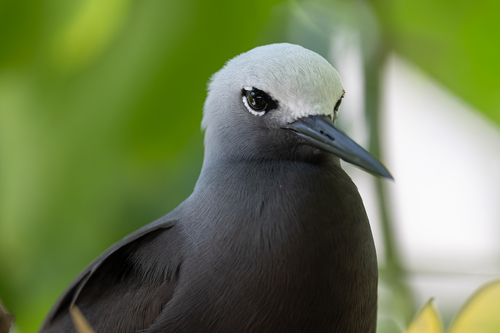
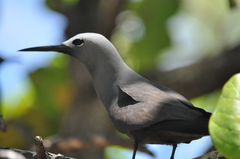
The lesser noddy (Anous tenuirostris), also known as the sooty noddy, is a seabird in the family Laridae. It is found near the coastlines of Comoros, Kenya, India, Maldives, Mauritius, Seychelles, Somalia, Sri Lanka and United Arab Emirates.

The lesser noddy was at one time considered as a subspecies of the black noddy (Anous minutus). The close relationship between the two species was confirmed by a molecular phylogenetic study published in 2016. The first formal description of the lesser noddy was by the Dutch zoologist Coenraad Jacob Temminck in 1823 under the binomial name Sterna tenuirostris. The genus Anous was introduced by the English naturalist James Francis Stephens in 1826. Anous is Ancient Greek for "stupid" or "foolish". The specific name tenuirostris is from the Latin tenuis for "slender" and -rostris "-billed".

There are two subspecies: The plumage is brownish... Wikipedia →

Sounds

Call0:12

Seychelles · 2025

© Dries Van de Loock · XC1061229 · CC BY-NC-ND 4.0

Alarm call1:16

Seychelles · 2018

© Simon Elliott · XC589437 · CC BY-NC-ND 4.0

Call0:04

Seychelles · 2022

© Alexander Schlatmann · XC713911 · CC BY-NC-SA 4.0

Global Distribution

Parks Where Found

# Park Country Daily sighting probability
1 iSimangaliso Wetland Park 🇿🇦 South Africa
<5%

More parks will be added in future updates.

Cities Where Found

# City Country Daily sighting probability
1 Mumbai 🇮🇳 India
<5%

Before you go

What are the chances of seeing a Lesser Noddy in Mumbai?

Rare

Under 5% of wildlife watchers report a Lesser Noddy sighting in Mumbai on a given day, based on 279 verified sightings from GBIF citizen-science data. It is the 128th most-seen of the 283 birds we can rate there. Over three days the chance rises to about 10%, and over a week to about 20%, if each day is a fresh chance.

When is the best time to see a Lesser Noddy in Mumbai?

September

In that month about 20% of wildlife watchers report a Lesser Noddy in Mumbai on a given day, against under 5% in October to June, the lowest months. That is one of Mumbai's wettest months, with about 380 mm of rain against almost none in January.

What time of day is best to see a Lesser Noddy?

Between 9 am and noon

Across all the parks we cover, that three-hour window holds the most Lesser Noddy sightings with a recorded time, and about 9 in 10 of them come between 6 am and 6 pm: it is a daytime animal.

Where else can you see a Lesser Noddy?

Only Mumbai, in our data

Mumbai is the only city on Wallace's Line with enough records to rate Lesser Noddy sightings: under 5% of wildlife watchers there report one on a given day.

Which relatives of the Lesser Noddy live in Mumbai?

Same family: Laridae

The closest relatives of the Lesser Noddy that you can see in Mumbai (family Laridae, Gulls, Terns, and Skimmers) are Whiskered Tern (about 20%), Gull-billed Tern (about 10%) and Brown-headed Gull (about 10%), with each one's daily chance of a sighting.

Where does the Lesser Noddy sighting chance come from?

GBIF citizen-science records

It is estimated from how often the Lesser Noddy is recorded against all the birds logged in Mumbai (279 verified sightings), calibrated against known sighting rates. Figures are rounded to the nearest 10% because citizen-science data supports honest approximations, not decimals, and months with records from fewer than five people show "—". How it works.

← Back to Mumbai