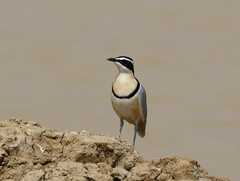
Egyptian Plover

Egyptian Plover

Pluvianus aegyptius

Silhouette: Sheatherius · PhyloPic

LCLeast ConcernNTVUENCR
Daily sighting probability ~10% · With luck
at N'Djamena

In 3 days ~30% in a week ~50%

7 Verified sightings at N'Djamena
325 In 1 park From 2019 to 2026
July Best month
☀️ Diurnal When it's spotted

About the Egyptian Plover

The Egyptian plover (Pluvianus aegyptius), also known as the crocodile bird, is a wader, the only member of the genus Pluvianus. It occurs in a band across Sub-Saharan Africa from Senegal in the west to Ethiopia in the east and south to parts of the Democratic Republic of the Congo. Despite the name, it no longer occurs in Egypt. The species was formerly placed with the pratincoles and coursers in the family, Glareolidae, but is now regarded as the sole member of its own monotypic family Pluvianidae.

The species is one of several plovers doubtfully associated with the "trochilus" bird mentioned by the Greek historian Herodotus in a supposed cleaning symbiosis with the Nile crocodile. The Egyptian plover was formally described in 1758 by the Swedish naturalist Carl Linnaeus in the tenth edition of his Systema Naturae. He placed it in the genus Charadrius and coined the binomial name Charadrius aegyptius. Linnaeus based his account on the description by the Swedish naturalist Fredrik Hasselqvist that had been published in 1757. The Egyptian plover is now the only species placed in the genus Pluvianus that was introduced in 1816 by the French ornithologist Louis Vieillot... Wikipedia →

Sounds

Call0:17

Senegal · 2026

© Peter Boesman · XC1081345 · CC BY-NC-ND 4.0

Alarm call0:39

Nigeria · 2020

© Sun Madakan · XC605867 · CC BY-NC-SA 4.0

Call0:27

Senegal · 2018

© Andrew Spencer · XC454585 · CC BY-NC-ND 4.0

Global Distribution

Parks Where Found

# Park Country Daily sighting probability
1 Niokolo-Koba National Park 🇸🇳 Senegal
~60%

More parks will be added in future updates.

Cities Where Found

# City Country Daily sighting probability
1 N'Djamena 🇹🇩 Chad
~10%

Zoos & Centres Where Found

# Zoo / Centre Country
1 San Diego Zoo 🇺🇸 United States In captivity
2 Pairi Daiza 🇧🇪 Belgium In captivity
3 Milwaukee County Zoo 🇺🇸 United States In captivity
4 Toledo Zoo 🇺🇸 United States In captivity
5 Philadelphia Zoo 🇺🇸 United States In captivity
6 Ueno Zoo 🇯🇵 Japan In captivity

Before you go

What are the chances of seeing an Egyptian Plover in N'Djamena?

With luck

About 10% of wildlife watchers report an Egyptian Plover sighting in N'Djamena on a given day, based on 7 verified sightings from GBIF citizen-science data. It is the 51st most-seen of the 70 birds we can rate there. Over three days the chance rises to about 30%, and over a week to about 50%, if each day is a fresh chance.

When is the best time to see an Egyptian Plover in N'Djamena?

July and September

In those months about 20% of wildlife watchers report an Egyptian Plover in N'Djamena on a given day, against under 5% in March and April, the lowest months. Those are among N'Djamena's wettest months, with about 110 mm of rain a month against almost none in January. June, August and October–December have too few records to rate.

What time of day is best to see an Egyptian Plover?

Between 10 am and 1 pm

Across all the parks we cover, that three-hour window holds the most Egyptian Plover sightings with a recorded time, and about 8 in 10 of them come between 6 am and 6 pm: it is a daytime animal.

Where else can you see an Egyptian Plover?

Only N'Djamena, in our data

N'Djamena is the only city on Wallace's Line with enough records to rate Egyptian Plover sightings: about 10% of wildlife watchers there report one on a given day.

Which relatives of the Egyptian Plover live in N'Djamena?

Same order: Charadriiformes

The closest relatives of the Egyptian Plover that you can see in N'Djamena (order Charadriiformes, Shorebirds and Allies) are African Jacana (about 30%), Spur-winged Lapwing (about 20%) and Greater Painted-Snipe (about 20%), with each one's daily chance of a sighting.

Where does the Egyptian Plover sighting chance come from?

GBIF citizen-science records

It is estimated from how often the Egyptian Plover is recorded against all the birds logged in N'Djamena (7 verified sightings), calibrated against known sighting rates. Figures are rounded to the nearest 10% because citizen-science data supports honest approximations, not decimals, and months with records from fewer than five people show "—". How it works.

← Back to N'Djamena