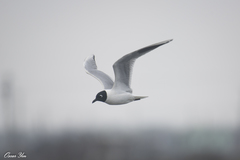
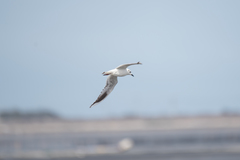
Saunders's Gull
Daily sighting probability <5% · Rare
at Nagoya

In 3 days <5% in a week ~10%

40 Verified sightings at Nagoya
January Best month

About the Saunders's Gull

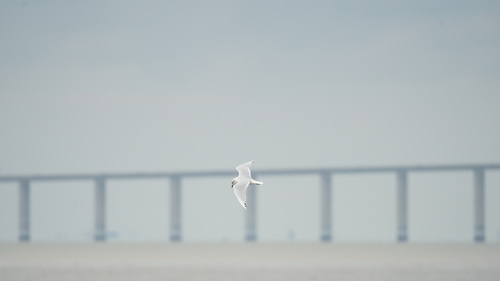
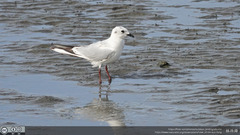
Saunders's gull (Saundersilarus saundersi) or Chinese black-headed gull, is a species of gull in the family Laridae. It is found in China, Japan, North Korea, South Korea, Macau, Russia, Taiwan, and Vietnam. Its natural habitats are estuarine waters and intertidal marshes. As with many other gulls, it has traditionally been placed in the genus Larus, but based on phylogenetic work some have moved it to Chroicocephalus, while others argue it is sufficiently distinct for placement in the monotypic Saundersilarus. In 2023, this transfer was accepted by the International Ornithologists' Union.

It is threatened by habitat loss, particularly by conversion of saltmarsh to agricultural land or fish farms, and industrial development including oil extraction. One of its few remaining strongholds are the Yancheng Coastal Wetlands, which hosts about 20% of the world's population.

Saunders's gull is named after the British ornithologist Howard Saunders. This is a very small species of gull with a length of just 33 cm (13 in) and, among gulls, only the little gull is smaller. Adults have a black hood and nape during the breeding season. It is very pale with a white body and tail... Wikipedia →
Global Distribution

Parks Where Found

# Park Country Daily sighting probability

More parks will be added in future updates.

Cities Where Found

# City Country Daily sighting probability
1 Quanzhou 🇨🇳 China
~10%
2 Dalian 🇨🇳 China
~10%
3 Busan 🇰🇷 South Korea
<5%
4 Seoul 🇰🇷 South Korea
<5%
5 Nagoya 🇯🇵 Japan
<5%
6 Tokyo 🇯🇵 Japan
<5%
7 Guangzhou 🇨🇳 China
<5%
8 Beijing 🇨🇳 China
<5%

Before you go

What are the chances of seeing a Saunders's Gull in Nagoya?

Rare

Under 5% of wildlife watchers report a Saunders's Gull sighting in Nagoya on a given day, based on 40 verified sightings from GBIF citizen-science data. It is the 97th most-seen of the 165 birds we can rate there. Over three days the chance rises to under 5%, and over a week to about 10%, if each day is a fresh chance.

When is the best time to see a Saunders's Gull in Nagoya?

January

In that month about 10% of wildlife watchers report a Saunders's Gull in Nagoya on a given day, against under 5% in February to December, the lowest months. That is one of Nagoya's driest months, with about 75 mm of rain against 230 mm in July.

Is Nagoya the best place to see a Saunders's Gull?

5th of 8

Of the 8 cities where we can rate Saunders's Gull sightings, Nagoya ranks 5th at under 5%. The best odds are in Quanzhou (China, about 10%), Dalian (China, about 10%) and Busan (South Korea, under 5%).

Where does the Saunders's Gull sighting chance come from?

GBIF citizen-science records

It is estimated from how often the Saunders's Gull is recorded against all the birds logged in Nagoya (40 verified sightings), calibrated against known sighting rates. Figures are rounded to the nearest 10% because citizen-science data supports honest approximations, not decimals, and months with records from fewer than five people show "—". How it works.

← Back to Nagoya