Mountain Hare

Mountain Hare

Lepus timidus

Silhouette: Jan A. Venter, Herbert H. T. Prins, David A. Balfour & Rob Slotow (vectorized by T. Michael Keesey) · PhyloPic

LCLeast ConcernNTVUENCR
Daily sighting probability ~10% · With luck
at Novosibirsk

In 3 days ~30% in a week ~60%

39 Verified sightings at Novosibirsk
58 In 1 park From 2019 to 2026
April Best month
🌅 Crepuscular When it's spotted

About the Mountain Hare

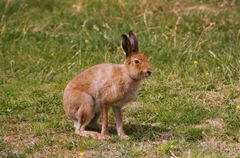
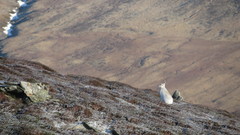
The mountain hare or arctic hare (Lepus timidus), also known as blue hare, tundra hare, variable hare, white hare, snow hare, alpine hare, and Irish hare, is a species of hare that is largely adapted to polar and mountainous habitats in the Palearctic realm. It is a large hare, slightly smaller than the European hare and identifiable by its tail, which is completely white throughout the year. Mountain hares have a brown coat in summer and white to grey in winter. Their diet is highly adaptive to their environment, but is generally made up of plant matter such as grass, twigs, and bark.

The scientific name Lepus timidus was proposed by Carl Linnaeus in 1758. The mountain hare arose during the Late Pleistocene; there is evidence that its range expanded during glaciations into southern Europe, with populations of the Iberian hare (Lepus granatensis), European hare (L. europaeus) and broom hare (L. castroviejoi) in northern Iberia harboring mitochondrial haplotypes from the mountain hare.

During the Late Pleistocene to Early Holocene, the mountain hare in Russia grew at least 10% larger than other hare species today. It was therefore classified as a distinct... Wikipedia →

Global Distribution

Parks Where Found

# Park Country Daily sighting probability
1 Cairngorms National Park 🇬🇧 United Kingdom
~30%

More parks will be added in future updates.

Cities Where Found

# City Country Daily sighting probability
1 Novosibirsk 🇷🇺 Russia
~10%

Zoos & Centres Where Found

# Zoo / Centre Country
1 Hellabrunn Zoo 🇩🇪 Germany In captivity
2 wildlife park Feldkirch 🇦🇹 Austria In captivity
3 Wildpark Feldkirch 🇦🇹 Austria In captivity
4 Hanover Zoo 🇩🇪 Germany In captivity
5 Sapporo Maruyama Zoo 🇯🇵 Japan In captivity
6 Asahiyama Zoo 🇯🇵 Japan In captivity
7 Zoopark Limpopo 🇷🇺 Russia In captivity
8 Alpenzoo Innsbruck 🇦🇹 Austria In captivity
9 Tierpark Schlichtweg 15 in München 🇩🇪 Germany In captivity
10 Zoo Schlichtweg 11 in München 🇩🇪 Germany In captivity
11 Zoo Siebenbrunner Straße 6 in München 🇩🇪 Germany In captivity

Before you go

What are the chances of seeing a Mountain Hare in Novosibirsk?

With luck

About 10% of wildlife watchers report a Mountain Hare sighting in Novosibirsk on a given day, based on 39 verified sightings from GBIF citizen-science data. It is the 3rd most-seen of the 10 mammals we can rate there. Over three days the chance rises to about 30%, and over a week to about 60%, if each day is a fresh chance.

When is the best time to see a Mountain Hare in Novosibirsk?

February–April and December

In those months about 20% of wildlife watchers report a Mountain Hare in Novosibirsk on a given day, against under 5% in June and August, the lowest months.

What time of day is best to see a Mountain Hare?

Between 8 and 11 am

Across all the parks we cover, that three-hour window holds the most Mountain Hare sightings with a recorded time, and about 6 in 10 of them come between 6 am and 6 pm: it is most active around dawn and dusk.

Where else can you see a Mountain Hare?

Only Novosibirsk, in our data

Novosibirsk is the only city on Wallace's Line with enough records to rate Mountain Hare sightings: about 10% of wildlife watchers there report one on a given day.

Where does the Mountain Hare sighting chance come from?

GBIF citizen-science records

It is estimated from how often the Mountain Hare is recorded against all the mammals logged in Novosibirsk (39 verified sightings), calibrated against known sighting rates. Figures are rounded to the nearest 10% because citizen-science data supports honest approximations, not decimals, and months with records from fewer than five people show "—". How it works.

← Back to Novosibirsk