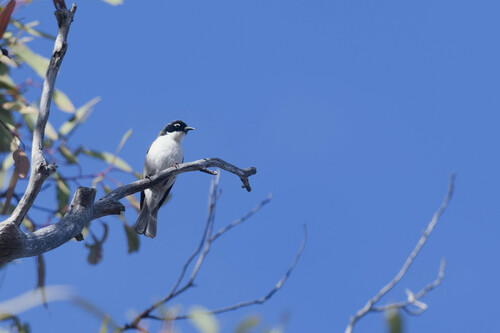
Western Spinebill

Western Spinebill

Acanthorhynchus superciliosus

LCLeast ConcernNTVUENCR Endemic
Daily sighting probability <5% · Rare
at Perth

In 3 days ~10% in a week ~20%

305 Verified sightings at Perth
April Best month

About the Western Spinebill

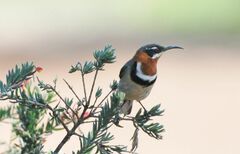
The western spinebill (Acanthorhynchus superciliosus) is a honeyeater found in the heath and woodland of south-western Australia. Ranging between 12–16 centimetres (4.7–6.3 in) long, it weighs around 10 grams (0.35 oz). It has a black head, gray back and wings, with a red band behind its neck and from its throat to its breast. Its curved bill is long and slender.

Like other honeyeaters, the western spinebill feeds on nectar. It tends to obtain its nectar from lower shrubs than most other honeyeaters, including Banksia, Dryandra, Grevillea, Adenanthos, and Verticordia. It also feeds from trees of Banksia and Eucalyptus, and from herbs such as Anigozanthos. In addition to nectar, it feeds on insects that it captures in the air or on plants.

It is a frequent visitor to Adenanthos obovatus, and its territories are smaller when they contain more shrubs of this species. Male spinebills often contest their territory borders with other males, and allow females to live within them. These territories range from 0.2 to 0.5 hectares in size. With their long curved bills, western spinebills are the only honeyeaters able to gain nectar out of the tube-like flowers.

It breeds from September to January, in a nest made from bark, plant stems, down and spider web. It lays 1–2 eggs, usually incubated by the female. Wikipedia →

Sounds

Song1:05

Australia · 2017

© Marc Anderson · XC382804 · CC BY-NC-ND 4.0

Recording0:30

Australia · 2023

© A.J. Anderson · iNaturalist · CC BY 4.0

Global Distribution

Parks Where Found

# Park Country Daily sighting probability

More parks will be added in future updates.

Cities Where Found

# City Country Daily sighting probability
1 Perth 🇦🇺 Australia
<5%

Before you go

What are the chances of seeing a Western Spinebill in Perth?

Rare

Under 5% of wildlife watchers report a Western Spinebill sighting in Perth on a given day, based on 305 verified sightings from GBIF citizen-science data. It is the 88th most-seen of the 162 birds we can rate there. Over three days the chance rises to about 10%, and over a week to about 20%, if each day is a fresh chance.

When is the best time to see a Western Spinebill in Perth?

March to June

In those months about 10% of wildlife watchers report a Western Spinebill in Perth on a given day, against under 5% in July to February, the lowest months.

Where else can you see a Western Spinebill?

Only Perth, in our data

Perth is the only city on Wallace's Line with enough records to rate Western Spinebill sightings: under 5% of wildlife watchers there report one on a given day.

Which relatives of the Western Spinebill live in Perth?

Same family: Meliphagidae

The closest relatives of the Western Spinebill that you can see in Perth (family Meliphagidae, Honeyeaters) are Red Wattlebird (about 90%), Singing Honeyeater (about 70%) and Brown Honeyeater (about 60%), with each one's daily chance of a sighting.

Where does the Western Spinebill sighting chance come from?

GBIF citizen-science records

It is estimated from how often the Western Spinebill is recorded against all the birds logged in Perth (305 verified sightings), calibrated against known sighting rates. Figures are rounded to the nearest 10% because citizen-science data supports honest approximations, not decimals, and months with records from fewer than five people show "—". How it works.

← Back to Perth