About the Tiger Rattlesnake
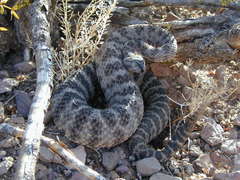
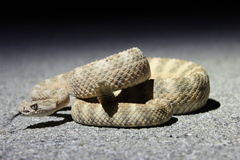
The tiger rattlesnake (Crotalus tigris) is a highly venomous pit viper species found in the southwestern United States and northwestern Mexico. No subspecies are currently recognized. The specific name tigris, (Latin for 'tiger'), refers to the many narrow dorsal crossbands, which create a pattern of vertical stripes when viewed from the side.
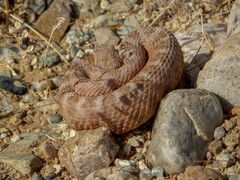
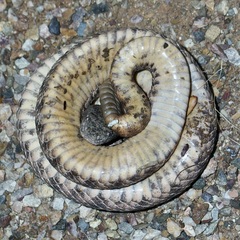
American herpetologist Robert Kennicott described the tiger rattlesnake in 1859. Common names include tiger rattlesnake and tiger rattler. The tiger rattlesnake is easily identified by its small, spade-shaped head, which is about 1/25 of its total body length. It has the smallest head of any rattlesnake, and a large rattle. The color pattern consists of a gray, lavender, blue-gray, pink, or buff ground color that usually turns to pink, pale orange, or cream on the sides. Tiger rattlesnakes are the only rattlesnake with crossbands on the anterior portion of their bodies, with a series of 35 to 52 gray, olive, or brown bands across the dorsum consisting mainly of heavy punctations. These crossbands have vague borders and are wider dorsally than laterally. Also mid-dorsally, the crossbands become wider than the spaces... Wikipedia →