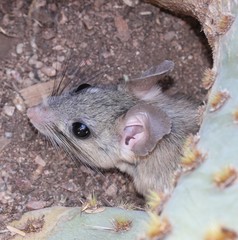
White-throated Woodrat

White-throated Woodrat

Neotoma albigula

Silhouette: T. Michael Keesey · PhyloPic

LCLeast ConcernNTVUENCR
Daily sighting probability ~10% · With luck
at Phoenix

In 3 days ~20% in a week ~40%

21 Verified sightings at Phoenix
51 In 1 park From 2019 to 2026
February Best month
🌅 Crepuscular When it's spotted

About the White-throated Woodrat

The white-throated woodrat (Neotoma albigula) is a species of rodent in the family Cricetidae. It is found from central Mexico north to Utah and Colorado in the United States. It is primarily a western species in the United States, extending from central Texas west to southeastern California. Populations east of the Rio Grande in New Mexico and Trans-Pecos Texas, previously considered to be variants of the white-throated woodrat, have since 1988 been assigned to the white-toothed woodrat (N. leucodon).

The animal lives mostly in the Upper and Lower Sonoran life zones, occurring from pinyon-juniper woodland in higher country to desert habitats at lower elevations. As with other species of woodrats, the white-throated woodrat constructs middens of a variety of materials such as sticks, cactus parts, and miscellaneous debris. An above-ground chamber within the midden contains a nest lined with grasses and kept free of feces. In non-rocky areas, the den usually is several feet in diameter and most commonly built around the base of a shrub that gives additional cover. In areas of rocky outcrops, crevices often are utilized, with sticks and other materials preventing free access to the nesting chamber.

Molecular data suggest that this species separated from other species of the Neotoma floridana group (Neotoma floridana, Neotoma micropus, Neotoma leucodon) about 155,000 years ago during the Illinoian Stage of the Pleistocene. This is consistent with the oldest known fossils from Slaton, Texas. This rodent is a common fossil in Southwestern cave faunas, with over 20 fossil localities of Pleistocene age known from New Mexico alone. Wikipedia →


Global Distribution

Parks Where Found

# Park Country Daily sighting probability
1 Saguaro National Park 🇺🇸 United States
~10%

More parks will be added in future updates.

Cities Where Found

# City Country Daily sighting probability
1 Phoenix 🇺🇸 United States
~10%

Zoos & Centres Where Found

# Zoo / Centre Country
1 Arizona-Sonora Desert Museum 🇺🇸 United States In captivity
2 Elmwood Park Zoo 🇺🇸 United States In captivity

Before you go

What are the chances of seeing a White-throated Woodrat in Phoenix?

With luck

About 10% of wildlife watchers report a White-throated Woodrat sighting in Phoenix on a given day, based on 21 verified sightings from GBIF citizen-science data. It is the 10th most-seen of the 14 mammals we can rate there. Over three days the chance rises to about 20%, and over a week to about 40%, if each day is a fresh chance.

When is the best time to see a White-throated Woodrat in Phoenix?

April–June, August and December–February

In those months about 10% of wildlife watchers report a White-throated Woodrat in Phoenix on a given day, against under 5% in March, July and September–November, the lowest months.

What time of day is best to see a White-throated Woodrat?

Between 7 and 10 am

Across all the parks we cover, that three-hour window holds the most White-throated Woodrat sightings with a recorded time, and about 6 in 10 of them come between 6 am and 6 pm: it is most active around dawn and dusk.

Where else can you see a White-throated Woodrat?

Only Phoenix, in our data

Phoenix is the only city on Wallace's Line with enough records to rate White-throated Woodrat sightings: about 10% of wildlife watchers there report one on a given day.

Where does the White-throated Woodrat sighting chance come from?

GBIF citizen-science records

It is estimated from how often the White-throated Woodrat is recorded against all the mammals logged in Phoenix (21 verified sightings), calibrated against known sighting rates. Figures are rounded to the nearest 10% because citizen-science data supports honest approximations, not decimals, and months with records from fewer than five people show "—". How it works.

← Back to Phoenix