
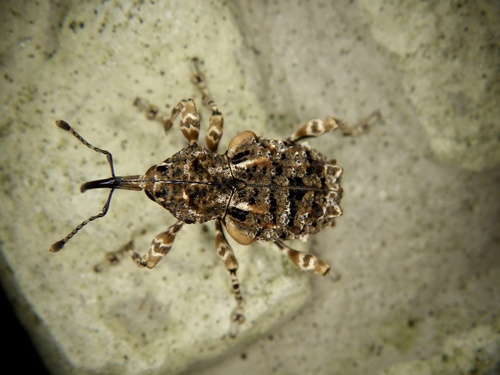
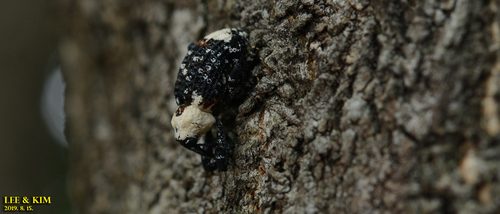
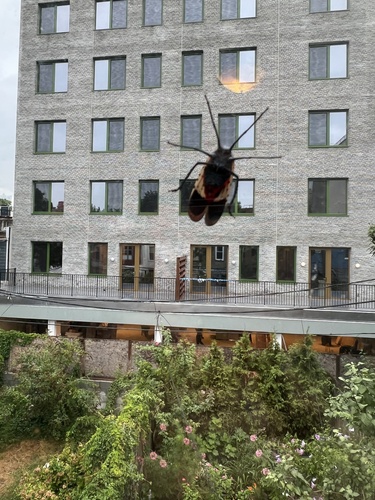
Red Necked Longhorn Beetle

Red Necked Longhorn Beetle

Aromia bungii

Daily sighting probability ~10% · With luck
at Qingdao

In 3 days ~40% in a week ~70%

14 Verified sightings at Qingdao
July Best month

About the Red Necked Longhorn Beetle

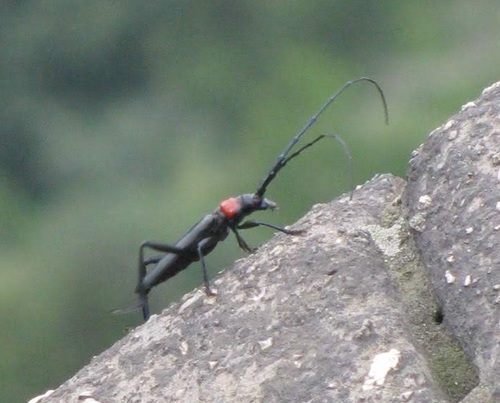
Aromia bungii, commonly known as red-necked longhorn beetle, is a species of wood-boring beetle belonging to the family of longhorn beetles (Cerambycidae) that is native to eastern Asia. It was described by the entomologist Franz Faldermann in 1835 from Mongolia. It is common and native in different parts of China and South Korea and has been reported from the neighboring parts of Vietnam, North Korea, far eastern Russia and Japan. Further, the beetle is invasive in Europe (first record in 2010) and Japan (first record in 2012), spreading with wood-packing materials and through infested nursery plants. As of 2025, infestations in Europe have been reported from different regions in Italy as well as from southern Germany. A. bungii is a pest of live fruit and ornamental trees from the genus Prunus (Rosaceae), in particular peach, cherry, plum and apricot trees. The larval stages feed mainly under the bark on the sapwood but can also bore into the heartwood. The infestations can cause considerable damage, with heavy attacks resulting in a reduction of fruits and growth, up to tree death. More than 50% of the trees in an orchard may be affected. For preventing infestations, painting a lime-sulfur mixture or other substances on the bark is practiced. Other management options include the use of pesticides and traps. In invaded areas, monitoring and quarantine procedures to prevent further spread is important. The adult beetles are around 25-35 mm long and can be recognized by the combination of the reddish pronotum and shiny black elytra. The red pronotum by itself is not sufficient for identification as some forms of the related species Aromia moschata also have a red pronotum. The females lay eggs in cracks in the bark, mainly at the base of the trees. Upon emerging from the eggs, the larvae tunnel into the trunk. They are whitish and reach a length of up to 50 mm when fully mature. Wikipedia →

Global Distribution

Parks Where Found

# Park Country Daily sighting probability

More parks will be added in future updates.

Cities Where Found

# City Country Daily sighting probability
1 Tianjin 🇨🇳 China
~30%
2 Qingdao 🇨🇳 China
~10%
3 Nanjing 🇨🇳 China
~10%
4 Shanghai 🇨🇳 China
~10%
5 Naples 🇮🇹 Italy
~10%
6 Osaka 🇯🇵 Japan
~10%
7 Suzhou 🇨🇳 China
~10%
8 Hangzhou 🇨🇳 China
~10%
9 Beijing 🇨🇳 China
~10%
10 Seoul 🇰🇷 South Korea
<5%

Before you go

What are the chances of seeing a Red Necked Longhorn Beetle in Qingdao?

With luck

About 10% of wildlife watchers report a Red Necked Longhorn Beetle sighting in Qingdao on a given day, based on 14 verified sightings from GBIF citizen-science data. It is the 10th most-seen of the 64 insects we can rate there. Over three days the chance rises to about 40%, and over a week to about 70%, if each day is a fresh chance.

When is the best time to see a Red Necked Longhorn Beetle in Qingdao?

July

In that month about 40% of wildlife watchers report a Red Necked Longhorn Beetle in Qingdao on a given day, against under 5% in August to May, the lowest months. That is one of Qingdao's wettest months, with about 180 mm of rain against 10 mm in January.

Is Qingdao the best place to see a Red Necked Longhorn Beetle?

2nd of 11

Of the 11 cities where we can rate Red Necked Longhorn Beetle sightings, Qingdao ranks 2nd at about 10%. The best odds are in Tianjin (China, about 30%).

Where does the Red Necked Longhorn Beetle sighting chance come from?

GBIF citizen-science records

It is estimated from how often the Red Necked Longhorn Beetle is recorded against all the insects logged in Qingdao (14 verified sightings), calibrated against known sighting rates. Figures are rounded to the nearest 10% because citizen-science data supports honest approximations, not decimals, and months with records from fewer than five people show "—". How it works.

← Back to Qingdao