About the Red-Tipped Clearwing Moth
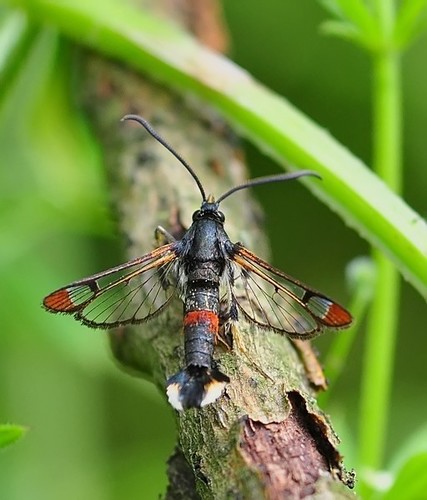
Synanthedon formicaeformis, the red-tipped clearwing, is a moth of the family Sesiidae and can be found in all of Europe, the eastern Palearctic realm, and the Near East. The larvae sometimes form pear-shaped galls on willows (Salix spp). It was first described by Eugenius Johann Christoph Esper in 1783.
The eggs are laid in axils, bark crevices or stump edges of Salix species from the end of May to late-July. The larvae feed inside the stems of various Salix species, including Salix viminalis. According to Heath and Emmet (1985) the larvae give little external sign apart from a slight browning, and at the edge of a broken stem frass may be seen. The larvae feed between the wood and the bark and can be found in their tunnels when the bark is peeled back. When there are galls they can be pear-shaped, or a ″peculiar shape″ with the ″diameter of the stem above the gall greater than that below, which continues for some distance″. Galls can be similar to the sallow clearwing (Synanthedon flaviventris).
The pupa is 12–14 mm long and does not make a cocoon. The emergence holes have a diameter of circa 2.5 mm and before pupation can be hidden by a thin cap. The exuviae can... Wikipedia →