Arboreal Salamander

Arboreal Salamander

Aneides lugubris

Silhouette: Benjamin Monod-Broca · PhyloPic

LCLeast ConcernNTVUENCR
Daily sighting probability <5% · Rare
at San Diego

In 3 days ~10%

6 Verified sightings at San Diego
January Best month
☀️🌙 Day & Night When it's spotted

About the Arboreal Salamander

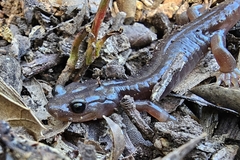
The arboreal salamander (Aneides lugubris) is a species of climbing salamander. An insectivore, it is native to California and Baja California, where it is primarily associated with oak and sycamore woodlands, and thick chaparral.

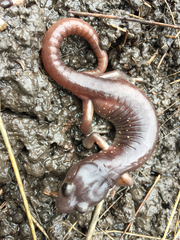
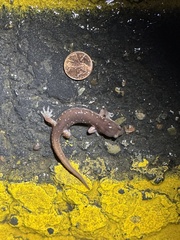
Aneides lugubris is 6.5–10 cm (2.6–3.9 in) SVL (snout-vent length), with plain purplish-brown coloring, usually spotted dorsally with gold or yellow, although it may also be unspotted. This salamander has longer and sharper teeth than many others within the order, Urodela. Aneides lugubris are insectivorous and have been found to eat beetles, caterpillars, sow bugs, ants, and centipedes. The tail is prehensile. The juvenile is dark overall, clouded with greyish color and fine yellow speckling on the back. The male of this species can be distinguished by its broad triangular head, with the front teeth of the jaw extending beyond the bottom lip. A large adult can inflict a painful bite.

This species is an excellent climber and difficult to capture. It is nocturnal, spending daylight hours and dry periods in the cavities of oak trees, often with many other individuals of its species. Having their primary habitat being in the trees, arboreal... Wikipedia →

Global Distribution

Parks Where Found

# Park Country Daily sighting probability

More parks will be added in future updates.

Cities Where Found

# City Country Daily sighting probability
1 San Francisco 🇺🇸 United States
~10%
2 San Diego 🇺🇸 United States
<5%

Before you go

What are the chances of seeing an Arboreal Salamander in San Diego?

Rare

Under 5% of wildlife watchers report an Arboreal Salamander sighting in San Diego on a given day, based on 6 verified sightings from GBIF citizen-science data. It is the 6th most-seen of the 6 amphibians we can rate there. Over three days the chance rises to about 10%, if each day is a fresh chance.

When is the best time to see an Arboreal Salamander in San Diego?

Any time of year

In every month with enough records, under 5% of wildlife watchers report an Arboreal Salamander in San Diego on a given day, so our monthly data shows no clear season.

What time of day is best to see an Arboreal Salamander?

Between 8 and 11 pm

Across all the parks we cover, that three-hour window holds the most Arboreal Salamander sightings with a recorded time, and about half of them come between 6 am and 6 pm: it is seen both by day and at night.

Is San Diego the best place to see an Arboreal Salamander?

2nd of 2

Of the 2 cities where we can rate Arboreal Salamander sightings, San Diego ranks 2nd at under 5%. The best odds are in San Francisco (United States, about 10%).

Where does the Arboreal Salamander sighting chance come from?

GBIF citizen-science records

It is estimated from how often the Arboreal Salamander is recorded against all the amphibians logged in San Diego (6 verified sightings), calibrated against known sighting rates. Figures are rounded to the nearest 10% because citizen-science data supports honest approximations, not decimals, and months with records from fewer than five people show "—". How it works.

← Back to San Diego