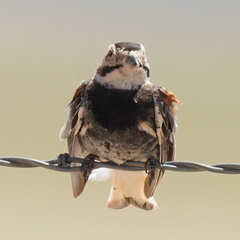
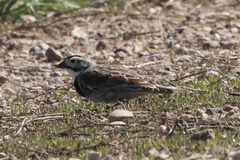
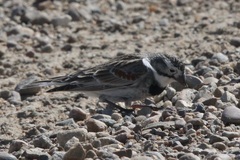
McCown's Longspur

McCown's Longspur

Rhynchophanes mccownii

Silhouette: Sheatherius · PhyloPic

LCLeast ConcernNTVUENCR
Daily sighting probability <5% · Rare
at San Diego

In 3 days ~10% in a week ~20%

17 Verified sightings at San Diego
February Best month
☀️ Diurnal When it's spotted

About the McCown's Longspur

The thick-billed longspur, also known as McCown's longspur (Rhynchophanes mccownii), is a small ground-feeding bird in the family Calcariidae, which also contains the other longspurs and snow buntings. It is found in North America and is the only species in the genus Rhynchophanes.

The thick-billed longspur was described in 1851 by the American amateur ornithologist George Newbold Lawrence under the English name rufous-winged lark bunting. He placed it in the genus Plectrophanes and coined the binomial name Plectrophanes mccownii. It was moved into its own genus Rhynchophanes in 1858 by Spencer Baird on account of its bill size and short spur, but was moved to Calcarius after a hybrid with the chestnut-collared longspur was discovered. It was once again placed in its own genus after a 2003 genetic study found it was more closely related to the snow buntings than the other longspurs.

"McCown's longspur" is no longer used by the American Ornithological Society, instead being changed to "thick-billed longspur", a literal translation of its genus name, Rhynchophanes. The IOC Bird List has followed suit with the name change.

The name "McCown" refers to Captain John P. McCown... Wikipedia →

Sounds

Call1:23

United States · 2013

© Paul Marvin · XC153625 · CC BY-NC-SA 3.0

Flight song0:45

United States · 2008

© Andrew Spencer · XC19139 · CC BY-NC-ND 2.5

Aerial displays0:30

United States · 2007

© Chris Parrish · XC14376 · CC BY-NC-ND 2.5

Global Distribution

Parks Where Found

# Park Country Daily sighting probability

More parks will be added in future updates.

Cities Where Found

# City Country Daily sighting probability
1 San Diego 🇺🇸 United States
<5%

Before you go

What are the chances of seeing a McCown's Longspur in San Diego?

Rare

Under 5% of wildlife watchers report a McCown's Longspur sighting in San Diego on a given day, based on 17 verified sightings from GBIF citizen-science data. It is the 155th most-seen of the 386 birds we can rate there. Over three days the chance rises to about 10%, and over a week to about 20%, if each day is a fresh chance.

When is the best time to see a McCown's Longspur in San Diego?

Any time of year

In every month with enough records, under 5% of wildlife watchers report a McCown's Longspur in San Diego on a given day, so our monthly data shows no clear season.

What time of day is best to see a McCown's Longspur?

Between 11 am and 2 pm

Across all the parks we cover, that three-hour window holds the most McCown's Longspur sightings with a recorded time, and about 9 in 10 of them come between 6 am and 6 pm: it is a daytime animal.

Where else can you see a McCown's Longspur?

Only San Diego, in our data

San Diego is the only city on Wallace's Line with enough records to rate McCown's Longspur sightings: under 5% of wildlife watchers there report one on a given day.

Where does the McCown's Longspur sighting chance come from?

GBIF citizen-science records

It is estimated from how often the McCown's Longspur is recorded against all the birds logged in San Diego (17 verified sightings), calibrated against known sighting rates. Figures are rounded to the nearest 10% because citizen-science data supports honest approximations, not decimals, and months with records from fewer than five people show "—". How it works.

← Back to San Diego