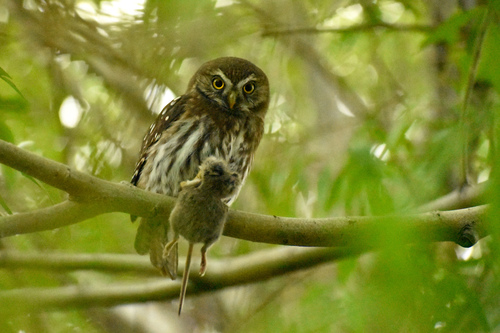
Magellanic Horned Owl

Magellanic Horned Owl

Bubo magellanicus

Silhouette: Edwin Price · PhyloPic

LCLeast ConcernNTVUENCR
Daily sighting probability <5% · Rare
at Santiago

In 3 days <5%

41 Verified sightings at Santiago
70 In all 2 parks From 2019 to 2026
December Best month
☀️🌙 Day & Night When it's spotted

About the Magellanic Horned Owl

The lesser horned owl or Magellanic horned owl (Bubo magellanicus) is a large owl of the genus Bubo found in southern South America, extending north to the central Andes. It has traditionally been classified as a subspecies of the great horned owl (Bubo virginianus), but is now treated as a separate species based on differences in voice and size and because of the genetic distance between the two.

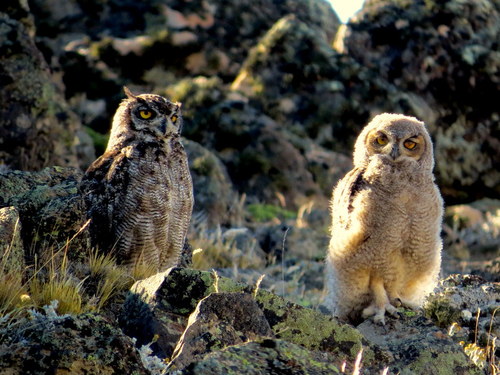
It is about 45 cm (18 in) long with birds in the north of the range being largest. It has broad wings and a large head with two "ear" tufts. The plumage is mainly grey-brown but is quite variable in colour. The underparts are pale with narrow grey-brown bars and the breast has dark blotches. There is a black border to the facial disc and white stripes above the yellow eyes. The great horned owl is similar but larger with stronger feet and bill, broader bars on the underparts and longer ear-tufts.

The deep hooting call consists of a double-note followed by a loud, vibrating note. The bird's local name tucúquere is imitative of the call. The range extends from central Peru and western Bolivia southwards through Chile and western Argentina as far as Tierra del Fuego. The bird occurs in a variety of habitats including open forest, scrubland, farmland and grassland. It hunts over open country, mainly at night. Rodents make up most of the diet but other mammals, birds, reptiles and insects are also taken. The species nests on cliffs or between rocks. The two or three eggs are incubated by the female, who is fed by the male. Wikipedia →
Sounds

Alarm call0:18

Chile · 2018

© Gonzalo Labarrera Valdivieso · XC513174 · CC BY-NC-SA 4.0

Song0:07

Chile · 2019

© Cristian Pinto · XC494435 · CC BY-NC-SA 4.0

Call0:04

Chile · 2016

© Fernando Medrano · XC313774 · CC BY-NC-SA 4.0

Global Distribution

Parks Where Found

# Park Country Daily sighting probability
1 Nahuel Huapi National Park 🇦🇷 Argentina
<5%
2 Torres del Paine National Park 🇨🇱 Chile
<5%

Cities Where Found

# City Country Daily sighting probability
1 Santiago 🇨🇱 Chile
<5%

Zoos & Centres Where Found

# Zoo / Centre Country
1 Zoorasia 🇯🇵 Japan In captivity
2 Safari Madrid 🇪🇸 Spain In captivity
3 Bioparque Municipal Vesty Pakos 🇧🇴 Bolivia In captivity
4 Buin Zoo 🇨🇱 Chile In captivity
5 Zoologico Mundo Andino - Tipon 🇵🇪 Peru In captivity
6 Zoológico de Concepción 🇨🇱 Chile In captivity
7 Arequipa zoo 🇵🇪 Peru In captivity

Before you go

What are the chances of seeing a Magellanic Horned Owl in Santiago?

Rare

Under 5% of wildlife watchers report a Magellanic Horned Owl sighting in Santiago on a given day, based on 41 verified sightings from GBIF citizen-science data. It is the 89th most-seen of the 110 birds we can rate there. Over three days the chance rises to under 5%, if each day is a fresh chance.

When is the best time to see a Magellanic Horned Owl in Santiago?

Any time of year

In every month with enough records, under 5% of wildlife watchers report a Magellanic Horned Owl in Santiago on a given day, so our monthly data shows no clear season.

What time of day is best to see a Magellanic Horned Owl?

Between 11 am and 2 pm

Across all the parks we cover, that three-hour window holds the most Magellanic Horned Owl sightings with a recorded time, and about 7 in 10 of them come between 6 am and 6 pm: it is seen both by day and at night.

Where else can you see a Magellanic Horned Owl?

Only Santiago, in our data

Santiago is the only city on Wallace's Line with enough records to rate Magellanic Horned Owl sightings: under 5% of wildlife watchers there report one on a given day.

Where does the Magellanic Horned Owl sighting chance come from?

GBIF citizen-science records

It is estimated from how often the Magellanic Horned Owl is recorded against all the birds logged in Santiago (41 verified sightings), calibrated against known sighting rates. Figures are rounded to the nearest 10% because citizen-science data supports honest approximations, not decimals, and months with records from fewer than five people show "—". How it works.

← Back to Santiago