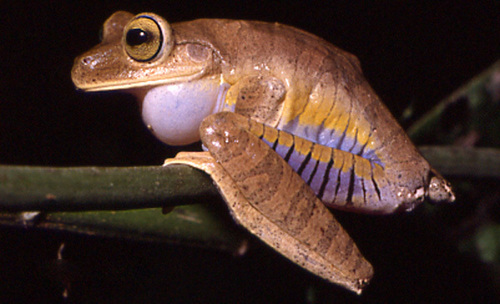
Guinle Treefrog

Guinle Treefrog

Aplastodiscus leucopygius

Silhouette: Dmitry Bogdanov (vectorized by T. Michael Keesey) · PhyloPic

LCLeast ConcernNTVUENCR Endemic
Daily sighting probability <5% · Rare
at São Paulo

In 3 days ~10% in a week ~30%

17 Verified sightings at São Paulo
February Best month
🌙 Nocturnal When it's spotted

About the Guinle Treefrog

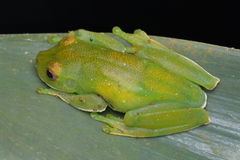
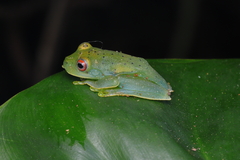
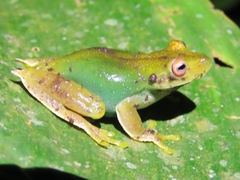
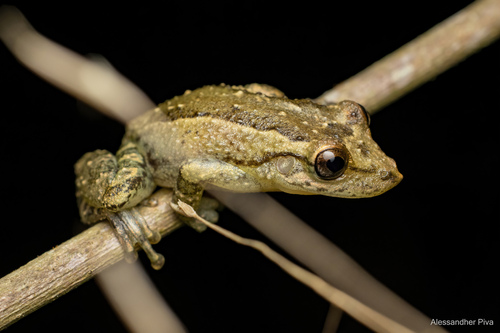
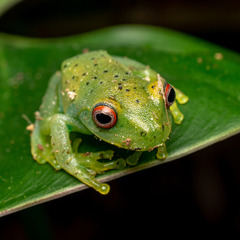
Aplastodiscus leucopygius is a species of frog in the family Hylidae. It is endemic to Brazil. A. leucopygius is a medium-sized frog growing to a length of about 4 cm (1.6 in). The snout is rounded, and a single vocal sac is on the throat. The iris is golden, tinged with orange around the edge, and the tympanum is clearly visible. The fingers and toes have large discs on the tips to help the frog retain grip when climbing. The dorsal surface of this frog is smooth and green, with a scattering of white spots, while the ventral surface is granular and cream-coloured with white flecks. The skin above the vent is ornamented by a short, white ridge.

A. leucopygius is an arboreal species and is endemic to the mountains near the south-eastern coast of Brazil at altitudes of 800 to 1,600 metres (2,600 to 5,200 ft) above sea level. It is mainly found in forested areas near streams or temporary pools.

Breeding takes place in the rainy season between December and February. The male calls from trees close to a body of water to attract a female. Often, several males near each other form a chorus. On the arrival, a female selects a male in an... Wikipedia →

Sounds

Recording0:18

Brazil · 2026

© Manequinho Correia · XC1078421 · CC BY-NC-SA 4.0

Recording0:13

Brazil · 2024

© Gabriel lima · iNaturalist · CC BY-NC 4.0

Global Distribution

Parks Where Found

# Park Country Daily sighting probability

More parks will be added in future updates.

Cities Where Found

# City Country Daily sighting probability
1 São Paulo 🇧🇷 Brazil
<5%

Before you go

What are the chances of seeing a Guinle Treefrog in São Paulo?

Rare

Under 5% of wildlife watchers report a Guinle Treefrog sighting in São Paulo on a given day, based on 17 verified sightings from GBIF citizen-science data. It is the 5th most-seen of the 13 amphibians we can rate there. Over three days the chance rises to about 10%, and over a week to about 30%, if each day is a fresh chance.

When is the best time to see a Guinle Treefrog in São Paulo?

February and September

In those months about 10% of wildlife watchers report a Guinle Treefrog in São Paulo on a given day, against under 5% in March–August and October–January, the lowest months.

What time of day is best to see a Guinle Treefrog?

Between 7 and 10 pm

Across all the parks we cover, that three-hour window holds the most Guinle Treefrog sightings with a recorded time, and about 8 in 10 of them come between 6 pm and 6 am: it is mostly seen at night.

Where else can you see a Guinle Treefrog?

Only São Paulo, in our data

São Paulo is the only city on Wallace's Line with enough records to rate Guinle Treefrog sightings: under 5% of wildlife watchers there report one on a given day.

Where does the Guinle Treefrog sighting chance come from?

GBIF citizen-science records

It is estimated from how often the Guinle Treefrog is recorded against all the amphibians logged in São Paulo (17 verified sightings), calibrated against known sighting rates. Figures are rounded to the nearest 10% because citizen-science data supports honest approximations, not decimals, and months with records from fewer than five people show "—". How it works.

← Back to São Paulo