Evening Cicada

Evening Cicada

Tanna japonensis

Daily sighting probability ~10% · With luck
at Sendai

In 3 days ~30% in a week ~60%

10 Verified sightings at Sendai
August Best month

About the Evening Cicada

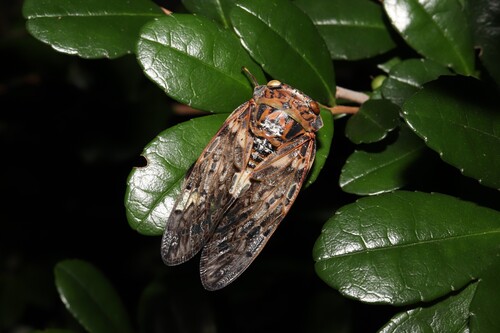
Tanna japonensis, also called the evening cicada or higurashi (Japanese: 日暮, 蜩, 茅蜩, ひぐらし, ヒグラシ), is a species of cicada, a family of insects, and a member of the genus Tanna. It is distributed throughout East Asia, and is most common in Japan. Its shrill call can be heard most often in the morning and evening.

One of its possible kanji names (茅蜩) is derived from the character (茅) for a category of grasses that includes Miscanthus sinensis, a type of reed that it inhabits. In Japan, it is also known as kanakana (カナカナ) because of the noise that it makes.

The adult male has a body length of 28–38 mm (1.1–1.5 in), the female is 21–25 mm (0.8–1.0 in). The male's abdomen is longer and thicker than that of the female, making it easy to distinguish between them. In addition, the intra-abdominal cavity of the male is more developed, giving it a more resonant call.

The body is coloured reddish-brown with green around the compound eye and in the centre and back of the thorax; mountain dwelling specimens tend to be darker. In Japan, their habitat ranges from temperate Hokkaido in the far north to subtropical Amami Ōshima, close to Taiwan (variants and subspecies... Wikipedia →

Global Distribution

Parks Where Found

# Park Country Daily sighting probability

More parks will be added in future updates.

Cities Where Found

# City Country Daily sighting probability
1 Sendai 🇯🇵 Japan
~10%
2 Osaka 🇯🇵 Japan
~10%
3 Tokyo 🇯🇵 Japan
<5%

Before you go

What are the chances of seeing an Evening Cicada in Sendai?

With luck

About 10% of wildlife watchers report an Evening Cicada sighting in Sendai on a given day, based on 10 verified sightings from GBIF citizen-science data. It is the 56th most-seen of the 128 insects we can rate there. Over three days the chance rises to about 30%, and over a week to about 60%, if each day is a fresh chance.

When is the best time to see an Evening Cicada in Sendai?

July and August

In those months about 30% of wildlife watchers report an Evening Cicada in Sendai on a given day, against under 5% in September to June, the lowest months. Those are among Sendai's wettest months, with about 190 mm of rain a month against 80 mm in February.

Is Sendai the best place to see an Evening Cicada?

Yes

Of the 3 cities where we can rate Evening Cicada sightings, Sendai has the highest daily chance: about 10%. Next come Osaka (Japan, about 10%) and Tokyo (Japan, under 5%).

Which relatives of the Evening Cicada live in Sendai?

Same family: Cicadidae

The closest relatives of the Evening Cicada that you can see in Sendai (family Cicadidae, Typical Cicadas) are Large Brown Cicada (about 30%), Robust Cicada (about 30%) and Kaempfer Cicada (about 10%), with each one's daily chance of a sighting.

Where does the Evening Cicada sighting chance come from?

GBIF citizen-science records

It is estimated from how often the Evening Cicada is recorded against all the insects logged in Sendai (10 verified sightings), calibrated against known sighting rates. Figures are rounded to the nearest 10% because citizen-science data supports honest approximations, not decimals, and months with records from fewer than five people show "—". How it works.

← Back to Sendai