Oriental Fire-bellied Toad

Oriental Fire-bellied Toad

Bombina orientalis

LCLeast ConcernNTVUENCR
Daily sighting probability ~10% · With luck
at Seoul

In 3 days ~30% in a week ~50%

37 Verified sightings at Seoul
September Best month
☀️🌙 Day & Night When it's spotted

About the Oriental Fire-bellied Toad

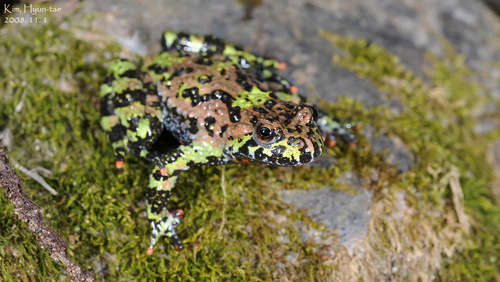
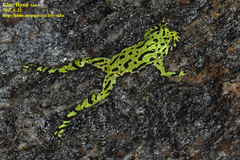
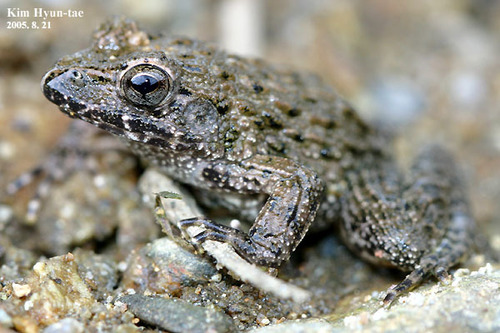
The Oriental fire-bellied toad (Bombina orientalis) is a small semiaquatic frog species found in northeastern Asia, where they primarily dwell in slow-moving bodies of water and temperate forests. Quite common throughout much of their range, these frogs have mild toxins that can be excreted through their skin, with their vibrant underbellies serving as a warning of this. While not a true toad, their green and black skin is covered in small tubercles, giving them a toadlike appearance. Their sounds, mainly produced by males during the mating season, are very unlike those of other frogs. While their population is in decline, their numbers are still high overall, with the International Union for Conservation of Nature (IUCN) rating them as a least-concern species. They are commonly kept as pets in land and water vivaria, as a relatively easy-to-care for species. They are also frequently used in scientific research, with their behavior, vocalizations, and learning skills all moderately studied.

According to the American Museum of Natural History, the red-bellied toad, Chinese bell toad, Oriental bell toad, eastern fire-bellied toad, and Korean fire-bellied toad are all common... Wikipedia →

Global Distribution

Parks Where Found

# Park Country Daily sighting probability

More parks will be added in future updates.

Cities Where Found

# City Country Daily sighting probability
1 Busan 🇰🇷 South Korea
~30%
2 Daegu 🇰🇷 South Korea
~30%
3 Qingdao 🇨🇳 China
~20%
4 Seoul 🇰🇷 South Korea
~10%
5 Beijing 🇨🇳 China
~10%

Zoos & Centres Where Found

# Zoo / Centre Country
1 National Zoological Park 🇺🇸 United States In captivity
2 Ostrava Zoo 🇨🇿 Czechia In captivity
3 Bronx Zoo 🇺🇸 United States In captivity
4 Cape May County Park & Zoo 🇺🇸 United States In captivity
5 São Paulo Zoo 🇧🇷 Brazil In captivity
6 Warsaw Zoo 🇵🇱 Poland In captivity
7 Berlin Zoological Garden 🇩🇪 Germany In captivity
8 Parken Zoo 🇸🇪 Sweden In captivity
9 Hanover Zoo 🇩🇪 Germany In captivity
10 Philadelphia Zoo 🇺🇸 United States In captivity
11 Forestry Farm Park and Zoo 🇨🇦 Canada In captivity
12 Faunia 🇪🇸 Spain In captivity
13 Lincoln Park Zoo 🇺🇸 United States In captivity
14 Little Rock Zoo 🇺🇸 United States In captivity
15 Plock Zoo 🇵🇱 Poland In captivity
16 Ueno Zoological Gardens (West Garden) 🇯🇵 Japan In captivity
17 Leningrad Zoo 🇷🇺 Russia In captivity
18 Jardin zoologique de la ville de Lyon 🇫🇷 France In captivity
19 Sao Paulo aquarium 🇧🇷 Brazil In captivity
20 Vancouver Aquarium 🇨🇦 Canada In captivity
21 Downtown Aquarium, Denver 🇺🇸 United States In captivity
22 Exotarium Sosnowiec 🇵🇱 Poland In captivity
23 Aquarium Berlin 🇩🇪 Germany In captivity
24 Aquarium of Gijón 🇪🇸 Spain In captivity
25 herpetarium warszawskiego ZOO 🇵🇱 Poland In captivity
26 akwarium warszawskiego ZOO 🇵🇱 Poland In captivity
27 hipopotamiarnia i akwarium morskie warszawskiego ZOO 🇵🇱 Poland In captivity
28 Reptielenzoo Iguana 🇳🇱 Netherlands In captivity

Before you go

What are the chances of seeing an Oriental Fire-bellied Toad in Seoul?

With luck

About 10% of wildlife watchers report an Oriental Fire-bellied Toad sighting in Seoul on a given day, based on 37 verified sightings from GBIF citizen-science data. It is the 6th most-seen of the 9 amphibians we can rate there. Over three days the chance rises to about 30%, and over a week to about 50%, if each day is a fresh chance.

When is the best time to see an Oriental Fire-bellied Toad in Seoul?

July to September

In those months about 20% of wildlife watchers report an Oriental Fire-bellied Toad in Seoul on a given day, against under 5% in December to April, the lowest months. Those are among Seoul's wettest months, with about 250 mm of rain a month against 20 mm in January.

What time of day is best to see an Oriental Fire-bellied Toad?

Between 8 and 11 pm

Across all the parks we cover, that three-hour window holds the most Oriental Fire-bellied Toad sightings with a recorded time, and about 6 in 10 of them come between 6 am and 6 pm: it is seen both by day and at night.

Is Seoul the best place to see an Oriental Fire-bellied Toad?

4th of 5

Of the 5 cities where we can rate Oriental Fire-bellied Toad sightings, Seoul ranks 4th at about 10%. The best odds are in Busan (South Korea, about 30%), Daegu (South Korea, about 30%) and Qingdao (China, about 20%).

Which relatives of the Oriental Fire-bellied Toad live in Seoul?

Same order: Anura

The closest relatives of the Oriental Fire-bellied Toad that you can see in Seoul (order Anura, Frogs and Toads) are Japanese Tree Frog (about 20%), Black-spotted Frog (about 20%) and Asiatic Toad (about 20%), with each one's daily chance of a sighting.

Where does the Oriental Fire-bellied Toad sighting chance come from?

GBIF citizen-science records

It is estimated from how often the Oriental Fire-bellied Toad is recorded against all the amphibians logged in Seoul (37 verified sightings), calibrated against known sighting rates. Figures are rounded to the nearest 10% because citizen-science data supports honest approximations, not decimals, and months with records from fewer than five people show "—". How it works.

← Back to Seoul