Ussuri Mamushi

Ussuri Mamushi

Gloydius ussuriensis

LCLeast ConcernNTVUENCR
Daily sighting probability <5% · Rare
at Seoul

In 3 days ~10% in a week ~30%

7 Verified sightings at Seoul
August Best month
☀️ Diurnal When it's spotted

About the Ussuri Mamushi

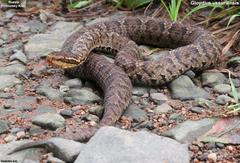
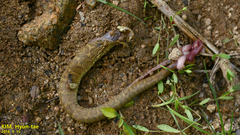
Gloydius ussuriensis is a venomous pitviper species endemic to far east Russia, northeastern China and the Korean Peninsula. No subspecies are currently recognized. Common names:Ussuri pit viper, Ussuri mamushi. Adult males are 37–63 cm (14.6–24.8 inches) in total length, while adult females are 41–64.7 cm (16.1–25.5 inches). However, this information, provided by Emelianov (1929), included two males of 37 cm (14.6 in) each which may have been subadults; the next largest male was 41.8 cm (16.5 in). Based on these same data, tail length in males was 12-17% of total length, while that in females was 12-15% of total length.

The scalation usually includes 21 rows of dorsal scales at midbody, all of which are keeled (although the keels on the first scale rows are faint), 146–157 ventral scales, and 39–54 subcaudal scales. There are 7 supralabial scales, with the second being the smallest and the fourth usually the largest.

The color pattern consists of a light brownish gray to blackish ground color overlaid with a series of 24–33 relatively large and usually elliptical dorsolateral blotches. These blotches, which may oppose or alternate on either side of the middorsal... Wikipedia →

Global Distribution

Parks Where Found

# Park Country Daily sighting probability

More parks will be added in future updates.

Cities Where Found

# City Country Daily sighting probability
1 Busan 🇰🇷 South Korea
~20%
2 Seoul 🇰🇷 South Korea
<5%

Before you go

What are the chances of seeing an Ussuri Mamushi in Seoul?

Rare

Under 5% of wildlife watchers report an Ussuri Mamushi sighting in Seoul on a given day, based on 7 verified sightings from GBIF citizen-science data. It is the 9th most-seen of the 13 reptiles we can rate there. Over three days the chance rises to about 10%, and over a week to about 30%, if each day is a fresh chance.

When is the best time to see an Ussuri Mamushi in Seoul?

May–June, August and November

In those months about 10% of wildlife watchers report an Ussuri Mamushi in Seoul on a given day, against under 5% in July, September–October and December–April, the lowest months.

What time of day is best to see an Ussuri Mamushi?

Between 10 am and 1 pm

Across all the parks we cover, that three-hour window holds the most Ussuri Mamushi sightings with a recorded time, and about 8 in 10 of them come between 6 am and 6 pm: it is a daytime animal.

Is Seoul the best place to see an Ussuri Mamushi?

2nd of 2

Of the 2 cities where we can rate Ussuri Mamushi sightings, Seoul ranks 2nd at under 5%. The best odds are in Busan (South Korea, about 20%).

Where does the Ussuri Mamushi sighting chance come from?

GBIF citizen-science records

It is estimated from how often the Ussuri Mamushi is recorded against all the reptiles logged in Seoul (7 verified sightings), calibrated against known sighting rates. Figures are rounded to the nearest 10% because citizen-science data supports honest approximations, not decimals, and months with records from fewer than five people show "—". How it works.

← Back to Seoul