
Grayish Eagle-Owl

Grayish Eagle-Owl

Bubo cinerascens

Silhouette: Steven Traver · PhyloPic

LCLeast ConcernNTVUENCR
Daily sighting probability <5% · Rare
at Serrekunda

In 3 days <5%

5 Verified sightings at Serrekunda
75 In all 3 parks From 2019 to 2026
December Best month
🌅 Crepuscular When it's spotted

About the Grayish Eagle-Owl

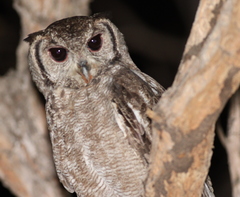
The greyish eagle-owl or vermiculated eagle-owl (Bubo cinerascens) is a rather large owl of the northern part of sub-Saharan Africa. It was previously regarded as the northern subspecies of the spotted eagle-owl (Bubo africanus).

This species is about 43 cm (17 in) long and weighs about 500 g (18 oz). Like the spotted eagle-owl, the greyish eagle-owl has mottled dark brown, buff, and white upperparts and finely barred (vermiculated) underparts giving a greyish-brown appearance. It differs from the spotted eagle-owl in having dark brown (not yellow) eyes and a brownish facial disk marked with a heavy brown circle around each eye. It also has morphological differences, such as being lighter though about the same length and having shorter tarsi.

As the greyish eagle-owl was considered the northern form of the spotted eagle-owl until recently their vocalisations have not been well studied. The call of the male recorded in West Africa consisted of two clear syllables and has been rendered as "koo-whoo" where the "koo" part is rather explosive and the "whoo" is somewhat downward inflected, lower pitched and extended. This call is made every few seconds and is... Wikipedia →

Sounds

Duet0:13

Senegal · 2025

© Azens · XC1059809 · CC BY-NC-SA 4.0

Call0:51

Senegal · 2024

© Frank Lambert · XC1041321 · CC BY-NC-ND 4.0

Song0:51

Ghana · 2022

© Peter Boesman · XC718897 · CC BY-NC-ND 4.0

Global Distribution

Parks Where Found

# Park Country Daily sighting probability
1 Murchison Falls National Park 🇺🇬 Uganda
<5%
2 Kidepo Valley National Park 🇺🇬 Uganda
<5%
3 Samburu National Reserve 🇰🇪 Kenya
<5%

Cities Where Found

# City Country Daily sighting probability
1 Serrekunda 🇬🇲 Gambia
<5%

Zoos & Centres Where Found

# Zoo / Centre Country
1 Espace Rambouillet 🇫🇷 France In captivity
2 Kano Zoo 🇳🇬 Nigeria In captivity
3 Small Breeds Farm Park 🇬🇧 United Kingdom In captivity
4 Audu Bako Zoo 🇳🇬 Nigeria In captivity
5 International Centre for Birds of Prey 🇬🇧 United Kingdom In captivity
6 Le centre de soins des rapaces Espace Rambouillet 🇫🇷 France In captivity

Before you go

What are the chances of seeing a Grayish Eagle-Owl in Serrekunda?

Rare

Under 5% of wildlife watchers report a Grayish Eagle-Owl sighting in Serrekunda on a given day, based on 5 verified sightings from GBIF citizen-science data. It is the 204th most-seen of the 213 birds we can rate there. Over three days the chance rises to under 5%, if each day is a fresh chance.

When is the best time to see a Grayish Eagle-Owl in Serrekunda?

Any time of year

In every month with enough records, under 5% of wildlife watchers report a Grayish Eagle-Owl in Serrekunda on a given day, so our monthly data shows no clear season.

What time of day is best to see a Grayish Eagle-Owl?

Between 5 and 8 pm

Across all the parks we cover, that three-hour window holds the most Grayish Eagle-Owl sightings with a recorded time, and about 6 in 10 of them come between 6 am and 6 pm: it is most active around dawn and dusk.

Where else can you see a Grayish Eagle-Owl?

Only Serrekunda, in our data

Serrekunda is the only city on Wallace's Line with enough records to rate Grayish Eagle-Owl sightings: under 5% of wildlife watchers there report one on a given day.

Which relatives of the Grayish Eagle-Owl live in Serrekunda?

Same family: Strigidae

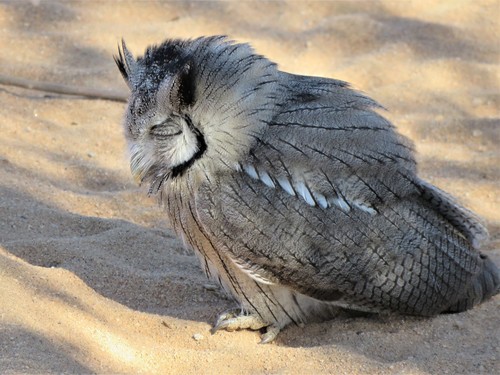
The closest relatives of the Grayish Eagle-Owl that you can see in Serrekunda (family Strigidae, Typical Owls) are Northern White-faced Owl (about 10%) and Pearl-spotted Owlet (about 10%), with each one's daily chance of a sighting.

Where does the Grayish Eagle-Owl sighting chance come from?

GBIF citizen-science records

It is estimated from how often the Grayish Eagle-Owl is recorded against all the birds logged in Serrekunda (5 verified sightings), calibrated against known sighting rates. Figures are rounded to the nearest 10% because citizen-science data supports honest approximations, not decimals, and months with records from fewer than five people show "—". How it works.

← Back to Serrekunda