White-billed Buffalo-Weaver

White-billed Buffalo-Weaver

Bubalornis albirostris

Silhouette: Sheatherius · PhyloPic

LCLeast ConcernNTVUENCR
Daily sighting probability ~20% · Possible
at Serrekunda

In 3 days ~60% in a week ~90%

213 Verified sightings at Serrekunda
53 In 1 park From 2019 to 2026
February Best month
☀️ Diurnal When it's spotted

About the White-billed Buffalo-Weaver

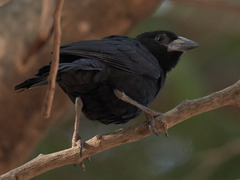
The white-billed buffalo weaver (Bubalornis albirostris) is a resident breeding bird species in most of Africa south of the Sahara Desert. This common weaver occurs in open country, especially cultivation and scrub. It is a communal breeder, building massive untidy stick nests in tree colonies, each of which may have several spherical woven nests within. Two to four eggs are laid.

The white-billed buffalo weaver is large and stocky, commonly measuring 23 to 24 centimeters. The adult is mainly black with white flecking on the back and wings. The conical bill is very thick, and appears more so because it is surmounted by a white frontal shield. The bill is white in breeding males.

The adult female and non-breeding male are similar, but the bill is black. Young birds are dark brown in plumage. The white-billed buffalo weaver is a gregarious species which feeds on grain and insects. This is a noisy bird, especially in colonies, with a range of cackles and squeaks.

Birds of The Gambia by Barlow, Wacher and Disley, ISBN 1-873403-32-1 Media related to Bubalornis albirostris at Wikimedia Commons Data related to White-billed buffalo weaver at Wikispecies... Wikipedia →

Sounds

Call0:24

Senegal · 2025

© Azens · XC1059825 · CC BY-NC-SA 4.0

Song0:22

Kenya · 2024

© Peter Boesman · XC947984 · CC BY-NC-ND 4.0

Call1:04

Gambia · 2025

© Romuald Mikusek · XC1041614 · CC BY-NC-SA 4.0

Global Distribution

Parks Where Found

# Park Country Daily sighting probability
1 Kidepo Valley National Park 🇺🇬 Uganda
~20%

More parks will be added in future updates.

Cities Where Found

# City Country Daily sighting probability
1 Maiduguri 🇳🇬 Nigeria
~30%
2 Serrekunda 🇬🇲 Gambia
~20%

Before you go

What are the chances of seeing a White-billed Buffalo-Weaver in Serrekunda?

Possible

About 20% of wildlife watchers report a White-billed Buffalo-Weaver sighting in Serrekunda on a given day, based on 213 verified sightings from GBIF citizen-science data. It is the 56th most-seen of the 213 birds we can rate there. Over three days the chance rises to about 60%, and over a week to about 90%, if each day is a fresh chance.

When is the best time to see a White-billed Buffalo-Weaver in Serrekunda?

February

In that month about 40% of wildlife watchers report a White-billed Buffalo-Weaver in Serrekunda on a given day, against about 10% in May–June and August–September, the lowest months. That is one of Serrekunda's driest months, with almost no rain against 290 mm in August.

What time of day is best to see a White-billed Buffalo-Weaver?

Between 8 and 11 am

Across all the parks we cover, that three-hour window holds the most White-billed Buffalo-Weaver sightings with a recorded time, and about 8 in 10 of them come between 6 am and 6 pm: it is a daytime animal.

Is Serrekunda the best place to see a White-billed Buffalo-Weaver?

2nd of 2

Of the 2 cities where we can rate White-billed Buffalo-Weaver sightings, Serrekunda ranks 2nd at about 20%. The best odds are in Maiduguri (Nigeria, about 30%).

Which relatives of the White-billed Buffalo-Weaver live in Serrekunda?

Same family: Ploceidae

The closest relatives of the White-billed Buffalo-Weaver that you can see in Serrekunda (family Ploceidae, Weavers and Allies) are Village Weaver (about 60%), Little Weaver (about 40%) and Olive-naped Weaver (about 20%), with each one's daily chance of a sighting.

Where does the White-billed Buffalo-Weaver sighting chance come from?

GBIF citizen-science records

It is estimated from how often the White-billed Buffalo-Weaver is recorded against all the birds logged in Serrekunda (213 verified sightings), calibrated against known sighting rates. Figures are rounded to the nearest 10% because citizen-science data supports honest approximations, not decimals, and months with records from fewer than five people show "—". How it works.

← Back to Serrekunda