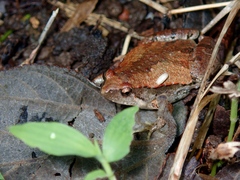
Ornate Chorus Frog

Ornate Chorus Frog

Microhyla fissipes

Silhouette: Vijay Karthick · PhyloPic

LCLeast ConcernNTVUENCR
Daily sighting probability ~20% · Possible
at Suzhou

In 3 days ~40% in a week ~70%

7 Verified sightings at Suzhou
August Best month
🌙 Nocturnal When it's spotted

About the Ornate Chorus Frog

Microhyla fissipes (commonly known as the ornate chorus frog) is a microhylid frog from East and Southeast Asia, from southern and central China and Taiwan to the Malay Peninsula. It was previously considered to be the same species as Microhyla ornata of South Asia; thus the common names ornate narrow-mouthed frog or ornamented pygmy frog can refer to either species.

As microhylids in general, Microhyla fissipes is a small frog: males reach 22–27 mm (0.87–1.06 in) and females 25–28 mm (0.98–1.10 in) in snout-vent length. Tadpoles are correspondingly small, about 22 mm (0.87 in) in total length.

Microhyla fissipes is a common and widespread species. It can be found in many habitat types including lowland scrub forests, grassland, agricultural land, pastureland and urban areas. Sub-fossorial in habit, it is also found in forest floor leaf-litter. It is mostly nocturnal, only active diurnally during the rainy season. It breeds in rain pools and other bodies of still water. It tolerates habitat modification and can also occur in non-intensively farmed agricultural land. In the Peninsular Malaysia, it inhabits upper hill and montane forest where... Wikipedia →

Sounds

Advertisement call0:14

China · 2025

© Dave Guo · XC978310 · CC BY-NC-SA 4.0

Recording0:06

China · 2025

© Amaël Borzée · iNaturalist · CC BY-NC 4.0

Recording0:07

China · 2022

© arkiawild · iNaturalist · CC BY-NC 4.0

Global Distribution

Parks Where Found

# Park Country Daily sighting probability

More parks will be added in future updates.

Cities Where Found

# City Country Daily sighting probability
1 Hefei 🇨🇳 China
~40%
2 Xiuying District 🇨🇳 China
~30%
3 Nanjing 🇨🇳 China
~30%
4 Wuhan 🇨🇳 China
~20%
5 Hangzhou 🇨🇳 China
~20%
6 Taipei 🇹🇼 Taiwan
~20%
7 Suzhou 🇨🇳 China
~20%
8 Shanghai 🇨🇳 China
~10%
9 Taichung 🇹🇼 Taiwan
~10%
10 Guangzhou 🇨🇳 China
~10%

Before you go

What are the chances of seeing an Ornate Chorus Frog in Suzhou?

Possible

About 20% of wildlife watchers report an Ornate Chorus Frog sighting in Suzhou on a given day, based on 7 verified sightings from GBIF citizen-science data. Over three days the chance rises to about 40%, and over a week to about 70%, if each day is a fresh chance.

When is the best time to see an Ornate Chorus Frog in Suzhou?

August

In that month about 40% of wildlife watchers report an Ornate Chorus Frog in Suzhou on a given day, against under 5% in July, September and November–April, the lowest months. That is one of Suzhou's wettest months, with about 160 mm of rain against 45 mm in December.

What time of day is best to see an Ornate Chorus Frog?

Between 7 and 10 pm

Across all the parks we cover, that three-hour window holds the most Ornate Chorus Frog sightings with a recorded time, and about 9 in 10 of them come between 6 pm and 6 am: it is mostly seen at night.

Is Suzhou the best place to see an Ornate Chorus Frog?

7th of 12

Of the 12 cities where we can rate Ornate Chorus Frog sightings, Suzhou ranks 7th at about 20%. The best odds are in Hefei (China, about 40%), Xiuying District (China, about 30%) and Nanjing (China, about 30%).

Which relatives of the Ornate Chorus Frog live in Suzhou?

Same order: Anura

The closest relatives of the Ornate Chorus Frog that you can see in Suzhou (order Anura, Frogs and Toads) are Asiatic Toad (about 40%), Eastern Golden Frog (about 20%) and Black-spotted Frog (about 10%), with each one's daily chance of a sighting.

Where does the Ornate Chorus Frog sighting chance come from?

GBIF citizen-science records

It is estimated from how often the Ornate Chorus Frog is recorded against all the amphibians logged in Suzhou (7 verified sightings), calibrated against known sighting rates. Figures are rounded to the nearest 10% because citizen-science data supports honest approximations, not decimals, and months with records from fewer than five people show "—". How it works.

← Back to Suzhou