Formosan Whistling-Thrush

Formosan Whistling-Thrush

Myophonus insularis

Silhouette: Martin Bulla, based on François Desbordes' illustration · PhyloPic

LCLeast ConcernNTVUENCR Endemic
Daily sighting probability ~10% · With luck
at Taipei

In 3 days ~20% in a week ~30%

1,511 Verified sightings at Taipei
661 In 1 park From 2019 to 2026
May Best month
🌅 Crepuscular When it's spotted

About the Formosan Whistling-Thrush

The Taiwan whistling thrush (Myophonus insularis), also known as the Formosan whistling thrush, is a species of bird in the family Muscicapidae. It is endemic to Taiwan. The Taiwan whistling thrush was collected by Robert Swinhoe and described as Myiophoneus insularis by John Gould in 1862. Swinhoe called it the "Formosan cavern-bird" because it inhabits the dark, forested ravines in the mountains. It was formerly considered a subspecies of the Malabar whistling thrush (Myophonus horsfieldii). The species is monotypic.

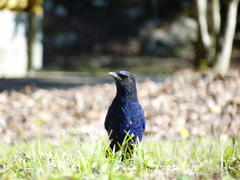
This thrush is endemic to Taiwan. Its natural habitat is subtropical or tropical moist montane forests. It is found at elevations of up to 2,700 m (8,900 ft). Its length is 28 to 30 cm (11 to 12 in). The wings are 15 to 16 cm (5.9 to 6.3 in) long. It is mostly blackish-blue. Some feathers are navy blue or metallic blue. Some underwing coverts have white bases. The underparts are blackish. Its neck, breast and flanks are scaled. Its eyes are deep red, and its lores, bill and legs are black. The two sexes are alike. The juvenile is dull blackish, with a bluish tinge. The gape of the juvenile is yellowish.... Wikipedia →

Sounds

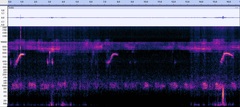
Call0:42

Taiwan · 2020

© An Chou · XC585360 · CC BY-NC-SA 4.0

Begging call0:55

Taiwan · 2012

© Ko Chie-Jen (Jerome) · XC127097 · CC BY-NC-SA 3.0

Song1:20

Taiwan · 2021

© Kuan-Chieh (Chuck) Hung, Taiwanbirdguide.com · XC632879 · CC BY-NC-SA 4.0

Global Distribution

Parks Where Found

# Park Country Daily sighting probability
1 Taroko National Park 🇹🇼 Taiwan
~30%

More parks will be added in future updates.

Cities Where Found

# City Country Daily sighting probability
1 Taipei 🇹🇼 Taiwan
~10%

Before you go

What are the chances of seeing a Formosan Whistling-Thrush in Taipei?

With luck

About 10% of wildlife watchers report a Formosan Whistling-Thrush sighting in Taipei on a given day, based on 1,511 verified sightings from GBIF citizen-science data. It is the 63rd most-seen of the 266 birds we can rate there. Over three days the chance rises to about 20%, and over a week to about 30%, if each day is a fresh chance.

When is the best time to see a Formosan Whistling-Thrush in Taipei?

March to September

In those months about 10% of wildlife watchers report a Formosan Whistling-Thrush in Taipei on a given day, against under 5% in October to February, the lowest months.

What time of day is best to see a Formosan Whistling-Thrush?

Between 3 and 6 am

Across all the parks we cover, that three-hour window holds the most Formosan Whistling-Thrush sightings with a recorded time, and about half of them come between 6 pm and 6 am: it is most active around dawn and dusk.

Where else can you see a Formosan Whistling-Thrush?

Only Taipei, in our data

Taipei is the only city on Wallace's Line with enough records to rate Formosan Whistling-Thrush sightings: about 10% of wildlife watchers there report one on a given day.

Which relatives of the Formosan Whistling-Thrush live in Taipei?

Same family: Muscicapidae

The closest relatives of the Formosan Whistling-Thrush that you can see in Taipei (family Muscicapidae, Old World Flycatchers, Robins, and Chats) are Oriental Magpie-Robin (about 40%), Daurian Redstart (about 10%) and Siberian Rubythroat (about 10%), with each one's daily chance of a sighting.

Where does the Formosan Whistling-Thrush sighting chance come from?

GBIF citizen-science records

It is estimated from how often the Formosan Whistling-Thrush is recorded against all the birds logged in Taipei (1,511 verified sightings), calibrated against known sighting rates. Figures are rounded to the nearest 10% because citizen-science data supports honest approximations, not decimals, and months with records from fewer than five people show "—". How it works.

← Back to Taipei