Common Castor Butterfly

Common Castor Butterfly

Ariadne merione

Daily sighting probability ~20% · Possible
at Tiruchirappalli

In 3 days ~50% in a week ~80%

6 Verified sightings at Tiruchirappalli
14 In all 2 parks From 2019 to 2026
December Best month
☀️ Diurnal When it's spotted

About the Common Castor Butterfly

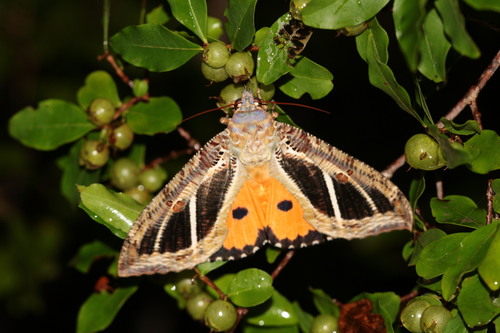
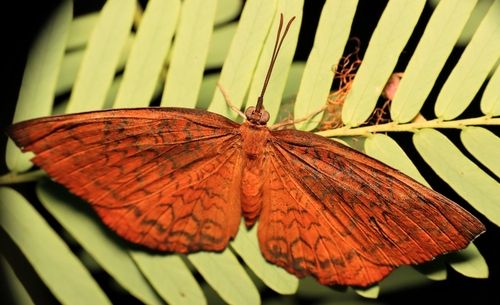
Ariadne merione, the common castor, is an orange butterfly with brown lines whose larvae feed almost exclusively on castor (Ricinus communis). It is similar in appearance to Ariadne ariadne, the angled castor. This species is found in South and Southeast Asia. Their wingspan ranges between 30 and 35 mm. Like others in the family Nymphalidae, their front two legs are small and unused, effectively making them four legged. These smaller appendages are covered with long hairs, giving them the characteristic brush look.

Male: Upperside brownish ochraceous. Forewings and hindwings crossed by slender, somewhat obscure, very sinuous or zigzag dark basal, two subbasal and two discal lines disposed in pairs, followed by a single, sometimes double, postdiscal and a single subterminal slender line. All these lines more or less interrupted anteriorly on the hindwing, which has a smooth unmarked uniform appearance from costa to subcostal vein and vein 5. On the forewing there is in addition a series of obscure spots between the postdiscal and subterminal markings, arid a small white subcostal spot before the apex.

Underside much as in Ariadne ariadne, but the... Wikipedia →
Global Distribution

Parks Where Found

# Park Country Daily sighting probability
1 Royal Manas National Park 🇧🇹 Bhutan
~30%
2 Kaeng Krachan National Park 🇹🇭 Thailand
~10%

Cities Where Found

# City Country Daily sighting probability
1 Jabalpur 🇮🇳 India
~40%
2 Salem 🇮🇳 India
~40%
3 Raipur 🇮🇳 India
~40%
4 Bengaluru 🇮🇳 India
~30%
5 Tiruppur 🇮🇳 India
~30%
6 Prayagraj 🇮🇳 India
~30%
7 Jamshedpur 🇮🇳 India
~30%
8 Lucknow 🇮🇳 India
~30%
9 Hyderabad 🇮🇳 India
~30%
10 Berhampore 🇮🇳 India
~30%

Before you go

What are the chances of seeing a Common Castor Butterfly in Tiruchirappalli?

Possible

About 20% of wildlife watchers report a Common Castor Butterfly sighting in Tiruchirappalli on a given day, based on 6 verified sightings from GBIF citizen-science data. It is the 23rd most-seen of the 30 insects we can rate there. Over three days the chance rises to about 50%, and over a week to about 80%, if each day is a fresh chance.

When is the best time to see a Common Castor Butterfly in Tiruchirappalli?

December and January

In those months about 40% of wildlife watchers report a Common Castor Butterfly in Tiruchirappalli on a given day, against under 5% in February, April–August and November, the lowest months. Those are among Tiruchirappalli's driest months, with about 40 mm of rain a month against 170 mm in November.

What time of day is best to see a Common Castor Butterfly?

Between 10 am and 1 pm

Across all the parks we cover, that three-hour window holds the most Common Castor Butterfly sightings with a recorded time, and about 9 in 10 of them come between 6 am and 6 pm: it is a daytime animal.

Is Tiruchirappalli the best place to see a Common Castor Butterfly?

20th of 29

Of the 29 cities where we can rate Common Castor Butterfly sightings, Tiruchirappalli ranks 20th at about 20%. The best odds are in Jabalpur (India, about 40%), Salem (India, about 40%) and Raipur (India, about 40%).

Which relatives of the Common Castor Butterfly live in Tiruchirappalli?

Same family: Nymphalidae

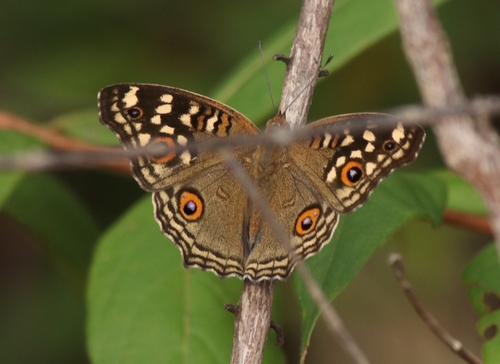
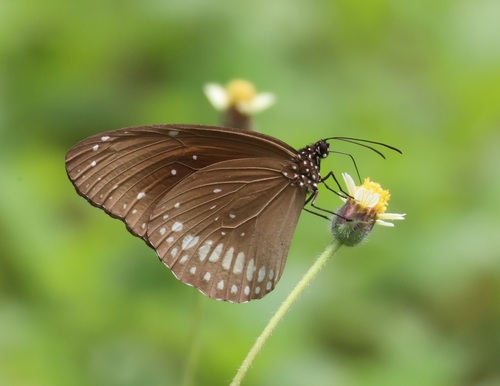
The closest relatives of the Common Castor Butterfly that you can see in Tiruchirappalli (family Nymphalidae, Brush-footed Butterflies) are Plain Tiger Butterfly (about 50%), Lemon Pansy (about 30%) and Common Crow (about 30%), with each one's daily chance of a sighting.

Where does the Common Castor Butterfly sighting chance come from?

GBIF citizen-science records

It is estimated from how often the Common Castor Butterfly is recorded against all the insects logged in Tiruchirappalli (6 verified sightings), calibrated against known sighting rates. Figures are rounded to the nearest 10% because citizen-science data supports honest approximations, not decimals, and months with records from fewer than five people show "—". How it works.

← Back to Tiruchirappalli