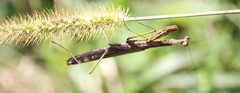
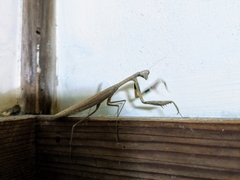
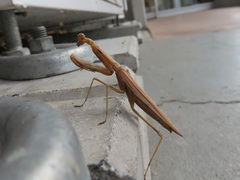
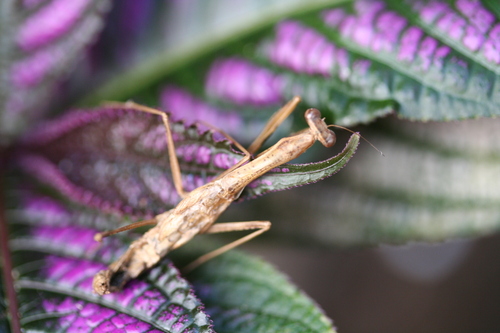
Asian Jumping Mantis

Asian Jumping Mantis

Statilia maculata

Daily sighting probability ~10% · With luck
at Tokyo

In 3 days ~20% in a week ~40%

134 Verified sightings at Tokyo
6 In 1 park From 2019 to 2026
October Best month
🌙 Nocturnal When it's spotted

About the Asian Jumping Mantis

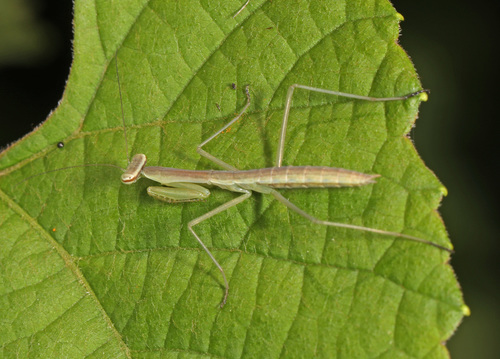
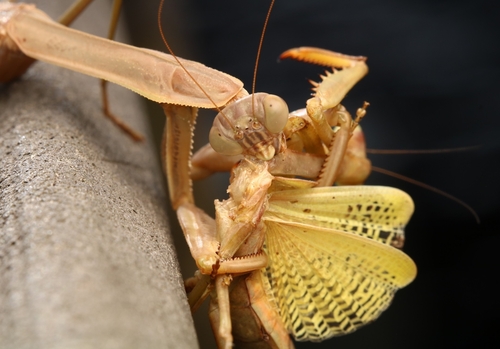
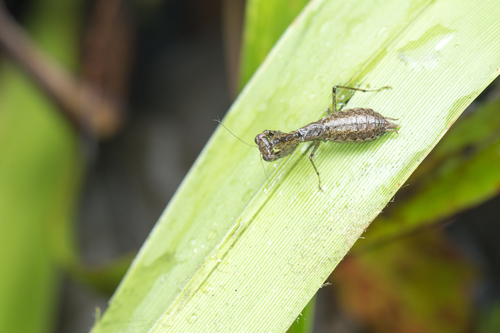
Statilia maculata, common name Asian jumping mantis or "小蟷螂", ko-kamakiri (Japanese meaning "small mantis") or "좀사마귀", jom-sa-ma-gui (Korean meaning "small mantis"), is a species of mantis native to Asia that can be found in Russia, China, Japan, Korea, and Sri Lanka.

Males are 40–50 mm in length as adults. Females are 45–58 mm in length as adults. The species was first described from the genus Mantis by Swedish naturalist Carl Peter Thunberg in 1784, who described the mantis as being from eastern India.

S. m. maculata China, Japan (Honshu, Shikoku, Kyushu), Taiwan, India (Andhra Pradesh, Arunachal Pradesh, Assam, Bihar, Himachal Pradesh, Kerala, Madhya Pradesh, Maharashtra, Meghalaya, Orissa, Sikkim, Uttar Pradesh, West Bengal), Java, Borneo, Nepal, Myanmar, New Guinea, Sri Lanka, Thailand, Korea

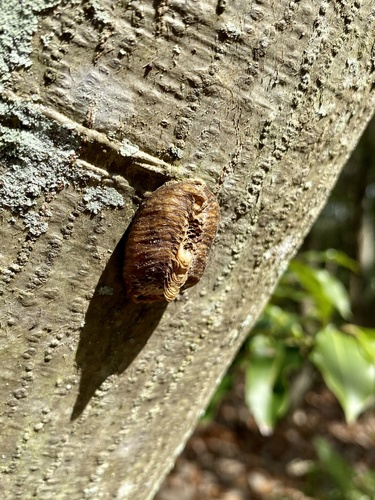
S. m. continentalis India (Uttar Pradesh) The species is eaten in Japan's Nagano prefecture, where the wings, limbs, and guts are removed prior to being cooked with sweetened soy sauce. The mantises' egg cases are also used medicinally in Japan and China.

Statilia maculata has a C-value of 3.05. Wikipedia →
Global Distribution

Parks Where Found

# Park Country Daily sighting probability
1 Taroko National Park 🇹🇼 Taiwan
~10%

More parks will be added in future updates.

Cities Where Found

# City Country Daily sighting probability
1 Tianjin 🇨🇳 China
~30%
2 Hefei 🇨🇳 China
~30%
3 Shenyang 🇨🇳 China
~20%
4 Jinan 🇨🇳 China
~20%
5 Baltimore 🇺🇸 United States
~20%
6 Sendai 🇯🇵 Japan
~20%
7 Nagoya 🇯🇵 Japan
~20%
8 Shanghai 🇨🇳 China
~10%
9 Seoul 🇰🇷 South Korea
~10%
10 Qingdao 🇨🇳 China
~10%

Before you go

What are the chances of seeing an Asian Jumping Mantis in Tokyo?

With luck

About 10% of wildlife watchers report an Asian Jumping Mantis sighting in Tokyo on a given day, based on 134 verified sightings from GBIF citizen-science data. It is the 114th most-seen of the 1013 insects we can rate there. Over three days the chance rises to about 20%, and over a week to about 40%, if each day is a fresh chance.

When is the best time to see an Asian Jumping Mantis in Tokyo?

October

In that month about 20% of wildlife watchers report an Asian Jumping Mantis in Tokyo on a given day, against under 5% in January to June, the lowest months. That is one of Tokyo's wettest months, with about 250 mm of rain against 75 mm in February.

What time of day is best to see an Asian Jumping Mantis?

Between 7 and 10 pm

Across all the parks we cover, that three-hour window holds the most Asian Jumping Mantis sightings with a recorded time, and about 8 in 10 of them come between 6 pm and 6 am: it is mostly seen at night.

Is Tokyo the best place to see an Asian Jumping Mantis?

15th of 22

Of the 22 cities where we can rate Asian Jumping Mantis sightings, Tokyo ranks 15th at about 10%. The best odds are in Tianjin (China, about 30%), Hefei (China, about 30%) and Shenyang (China, about 20%).

Which relatives of the Asian Jumping Mantis live in Tokyo?

Same family: Mantidae

The closest relatives of the Asian Jumping Mantis that you can see in Tokyo (family Mantidae, Mantids) are Giant Asian Mantis (about 20%) and Chinese Mantis (about 20%), with each one's daily chance of a sighting.

Where does the Asian Jumping Mantis sighting chance come from?

GBIF citizen-science records

It is estimated from how often the Asian Jumping Mantis is recorded against all the insects logged in Tokyo (134 verified sightings), calibrated against known sighting rates. Figures are rounded to the nearest 10% because citizen-science data supports honest approximations, not decimals, and months with records from fewer than five people show "—". How it works.

← Back to Tokyo