Masked Palm Civet

Masked Palm Civet

Paguma larvata

Silhouette: Margot Michaud · PhyloPic

LCLeast ConcernNTVUENCR
Daily sighting probability ~10% · With luck
at Tokyo

In 3 days ~20% in a week ~40%

82 Verified sightings at Tokyo
13 In all 2 parks From 2019 to 2026
July Best month
☀️ Diurnal When it's spotted

About the Masked Palm Civet

The masked palm civet (Paguma larvata), also called the gem-faced civet or Himalayan palm civet, is a viverrid species native to the Indian subcontinent and Southeast Asia. It has been listed as least concern on the IUCN Red List since 2008 as it occurs in many protected areas, is tolerant to some degree of habitat modification, and widely distributed with presumed large populations that are unlikely to be declining.

The genus Paguma was first named and described by John Edward Gray in 1831. All described forms are regarded as a single species. In 2003, masked palm civets at a wildlife market in China were found to have been infected with the severe acute respiratory syndrome coronavirus.

The genus name Paguma was first proposed and described by John Edward Gray in 1831. Reginald Innes Pocock thought the genus comprises two species, namely: P. lanigera in northern Nepal and Tibet and P. larvata with eight subspecies from the Himalayan foothills to southern China, Southeast Asia up to Indonesia.

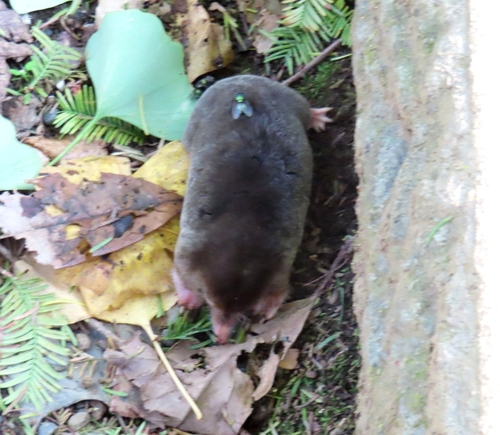
The masked palm civet's fur is grayish to ochraceous, black on the head, shoulders and neck, and blackish brown on the tail and feet. It has a white blaze... Wikipedia →

Sounds

Recording0:15

Taiwan · 2024

© callumstephenson · iNaturalist · CC BY-NC 4.0

Global Distribution

Parks Where Found

# Park Country Daily sighting probability
1 Cuc Phuong National Park 🇻🇳 Vietnam
~20%
2 Kaeng Krachan National Park 🇹🇭 Thailand
~10%

Cities Where Found

# City Country Daily sighting probability
1 Sendai 🇯🇵 Japan
~80%
2 Taipei 🇹🇼 Taiwan
~20%
3 Hong Kong 🇨🇳 China
~10%
4 Taichung 🇹🇼 Taiwan
~10%
5 Tokyo 🇯🇵 Japan
~10%
6 Osaka 🇯🇵 Japan
~10%
7 Kaohsiung 🇹🇼 Taiwan
~10%

Zoos & Centres Where Found

# Zoo / Centre Country
1 Zoo Pilsen 🇨🇿 Czechia In captivity
2 Beijing Wildlife Park 🇨🇳 China In captivity
3 Taipei Zoo 🇹🇼 Taiwan In captivity
4 Kadoorie Farm and Botanic Garden 🇭🇰 Hong Kong SAR China In captivity
5 Shenzhen Safari Park 🇨🇳 China In captivity
6 Tama Zoological Park 🇯🇵 Japan In captivity
7 La Torbiera 🇮🇹 Italy In captivity
8 Night Safari 🇸🇬 Singapore In captivity
9 Saigon Zoo and Botanical Gardens 🇻🇳 Vietnam In captivity
10 Shoushan Zoo 🇹🇼 Taiwan In captivity
11 Wild Elephant Valley 🇨🇳 China In captivity

Before you go

What are the chances of seeing a Masked Palm Civet in Tokyo?

With luck

About 10% of wildlife watchers report a Masked Palm Civet sighting in Tokyo on a given day, based on 82 verified sightings from GBIF citizen-science data. It is the 4th most-seen of the 11 mammals we can rate there. Over three days the chance rises to about 20%, and over a week to about 40%, if each day is a fresh chance.

When is the best time to see a Masked Palm Civet in Tokyo?

January and March–November

In those months about 10% of wildlife watchers report a Masked Palm Civet in Tokyo on a given day, against under 5% in February and December, the lowest months.

What time of day is best to see a Masked Palm Civet?

Between 1 and 4 pm

Across all the parks we cover, that three-hour window holds the most Masked Palm Civet sightings with a recorded time, and about 7 in 10 of them come between 6 am and 6 pm: it is a daytime animal.

Is Tokyo the best place to see a Masked Palm Civet?

5th of 7

Of the 7 cities where we can rate Masked Palm Civet sightings, Tokyo ranks 5th at about 10%. The best odds are in Sendai (Japan, about 80%), Taipei (Taiwan, about 20%) and Hong Kong (China, about 10%).

Which relatives of the Masked Palm Civet live in Tokyo?

Same order: Carnivora

The closest relatives of the Masked Palm Civet that you can see in Tokyo (order Carnivora, Carnivorans) are Common Raccoon (about 10%), Red Fox (about 10%) and Japanese Badger (about 10%), with each one's daily chance of a sighting.

Where does the Masked Palm Civet sighting chance come from?

GBIF citizen-science records

It is estimated from how often the Masked Palm Civet is recorded against all the mammals logged in Tokyo (82 verified sightings), calibrated against known sighting rates. Figures are rounded to the nearest 10% because citizen-science data supports honest approximations, not decimals, and months with records from fewer than five people show "—". How it works.

← Back to Tokyo