Squeaking Silkmoth

Squeaking Silkmoth

Rhodinia fugax

Daily sighting probability <5% · Rare
at Tokyo

In 3 days ~10% in a week ~20%

14 Verified sightings at Tokyo
February Best month

About the Squeaking Silkmoth

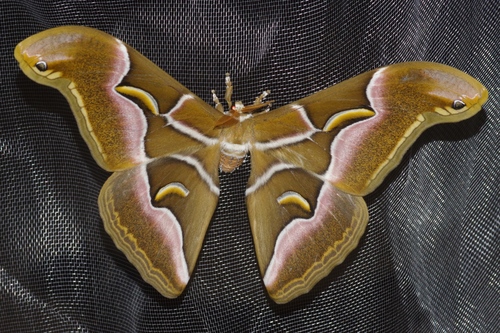
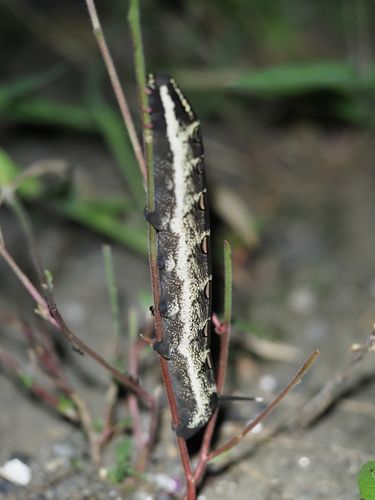
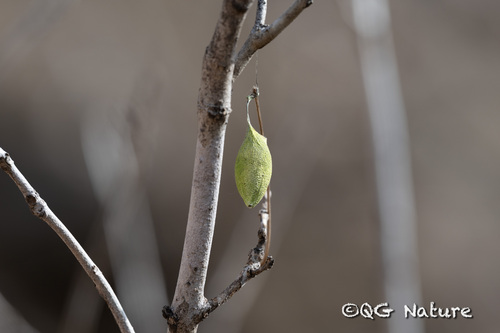
Rhodinia fugax, the squeaking silkmoth, is a moth in the family Saturniidae. It was described by Arthur Gardiner Butler in 1877. It is native to Korea, Japan, China, and the Russian Far East. The squeaking silkmoth is known as ウスタビガ (usutabiga, 薄手火蛾) in the Japanese language, 透目大蚕蛾 (tòu mù dà cán'é) in the Chinese language, and 유리산누에나방 (yurisannuenabang) in the Korean language. The Japanese common name translates to "thin hand fire moth", with tabi, "hand fire" being an archaic term for a lantern. The "lanterns" refer to the pupae left behind by the moths after their emergence, which, on defoliated trees in winter, resemble lanterns. The English epithet is derived from the caterpillar's defense mechanism, which consists of an audible squeaking akin to that of a squeak toy. The sound is produced through rapid bodily contraction, which forces air through the spiracles of the larva.

The pupae of R. fugax are separately known as ヤマカマス (yama-kamasu). They were named because of their resemblance to kamasu, folded straw mats used as storage. Cocoons from R. fugax were used historically to treat whooping cough on top of various usages as folk remedies, silk from its cocoons have been used as a type of wild silk. Wikipedia →
Global Distribution

Parks Where Found

# Park Country Daily sighting probability

More parks will be added in future updates.

Cities Where Found

# City Country Daily sighting probability
1 Tokyo 🇯🇵 Japan
<5%

Before you go

What are the chances of seeing a Squeaking Silkmoth in Tokyo?

Rare

Under 5% of wildlife watchers report a Squeaking Silkmoth sighting in Tokyo on a given day, based on 14 verified sightings from GBIF citizen-science data. It is the 585th most-seen of the 1013 insects we can rate there. Over three days the chance rises to about 10%, and over a week to about 20%, if each day is a fresh chance.

When is the best time to see a Squeaking Silkmoth in Tokyo?

January and February

In those months about 10% of wildlife watchers report a Squeaking Silkmoth in Tokyo on a given day, against under 5% in March to December, the lowest months. Those are among Tokyo's driest months, with about 80 mm of rain a month against 250 mm in October.

Where else can you see a Squeaking Silkmoth?

Only Tokyo, in our data

Tokyo is the only city on Wallace's Line with enough records to rate Squeaking Silkmoth sightings: under 5% of wildlife watchers there report one on a given day.

Where does the Squeaking Silkmoth sighting chance come from?

GBIF citizen-science records

It is estimated from how often the Squeaking Silkmoth is recorded against all the insects logged in Tokyo (14 verified sightings), calibrated against known sighting rates. Figures are rounded to the nearest 10% because citizen-science data supports honest approximations, not decimals, and months with records from fewer than five people show "—". How it works.

← Back to Tokyo