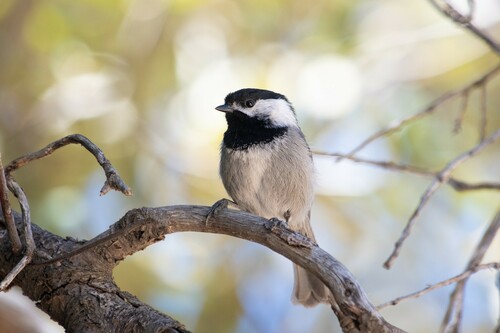
Mexican Chickadee

Mexican Chickadee

Poecile sclateri

Silhouette: Andy Wilson · PhyloPic

LCLeast ConcernNTVUENCR
Daily sighting probability ~20% · Possible
at Toluca

In 3 days ~60% in a week ~80%

43 Verified sightings at Toluca
142 In all 2 parks From 2019 to 2026
September Best month
☀️ Diurnal When it's spotted

About the Mexican Chickadee

The Mexican chickadee (Poecile sclateri) is a small passerine songbird in the family Paridae, the tits and chickadees. It is found in Mexico and the U. S. states of Arizona and New Mexico. The Mexican chickadee was originally described in 1857 as Parus meridionalis by Philip Sclater. However, that species name had already been applied to another species (the marsh tit, now Poecile palustris), by Wilhelm Lilljeborg in 1852, invalidating Sclater's name under the principle of priority. Otto Kleinschmidt noted this, and renamed it Parus sclateri in 1897, honoring the original discoverer. It remained included in the genus Parus for much of the twentieth century. Following a 1996 publication, in 1998 the American Ornithologists' Union reassigned it to Poecile, a genus that had been erected in 1829 and had long been treated as a subgenus of Parus. A 2005 paper used mtDNA cytochrome b sequence data and morphology to agree with that change and suggest it should be universally adopted. BirdLife International's Handbook of the Birds of the World did so in 2016 and the IOC and the Clements taxonomy followed suit by 2018.

The Mexican chickadee has four accepted subspecies... Wikipedia →

Sounds

Call1:27

Mexico · 2026

© Manuel Grosselet · XC1107058 · CC BY-NC-SA 4.0

Alarm call0:54

United States · 2023

© Richard E. Webster · XC936631 · CC BY-NC-SA 4.0

Song0:10

Mexico · 2020

© Fernando Uranga M. · XC608997 · CC BY-NC-SA 4.0

Global Distribution

Parks Where Found

# Park Country Daily sighting probability
1 Reserva de la Biosfera Mariposa Monarca 🇲🇽 Mexico
~30%
2 Cumbres de Monterrey National Park 🇲🇽 Mexico
<5%

Cities Where Found

# City Country Daily sighting probability
1 Toluca 🇲🇽 México
~20%
2 Mexico City 🇲🇽 México
<5%

Before you go

What are the chances of seeing a Mexican Chickadee in Toluca?

Possible

About 20% of wildlife watchers report a Mexican Chickadee sighting in Toluca on a given day, based on 43 verified sightings from GBIF citizen-science data. It is the 35th most-seen of the 118 birds we can rate there. Over three days the chance rises to about 60%, and over a week to about 80%, if each day is a fresh chance.

When is the best time to see a Mexican Chickadee in Toluca?

September

In that month about 50% of wildlife watchers report a Mexican Chickadee in Toluca on a given day, against about 10% in March, May and July, the lowest months. That is one of Toluca's wettest months, with about 150 mm of rain against 5 mm in December.

What time of day is best to see a Mexican Chickadee?

Between 8 and 11 am

Across all the parks we cover, that three-hour window holds the most Mexican Chickadee sightings with a recorded time, and nearly all of them come between 6 am and 6 pm: it is a daytime animal.

Is Toluca the best place to see a Mexican Chickadee?

Yes

Of the 2 cities where we can rate Mexican Chickadee sightings, Toluca has the highest daily chance: about 20%. Next come Mexico City (México, under 5%).

Which relatives of the Mexican Chickadee live in Toluca?

Same order: Passeriformes

The closest relatives of the Mexican Chickadee that you can see in Toluca (order Passeriformes, Perching Birds) are House Finch (about 80%), Canyon Towhee (about 80%) and Bushtit (about 70%), with each one's daily chance of a sighting.

Where does the Mexican Chickadee sighting chance come from?

GBIF citizen-science records

It is estimated from how often the Mexican Chickadee is recorded against all the birds logged in Toluca (43 verified sightings), calibrated against known sighting rates. Figures are rounded to the nearest 10% because citizen-science data supports honest approximations, not decimals, and months with records from fewer than five people show "—". How it works.
← Back to Toluca