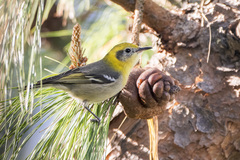
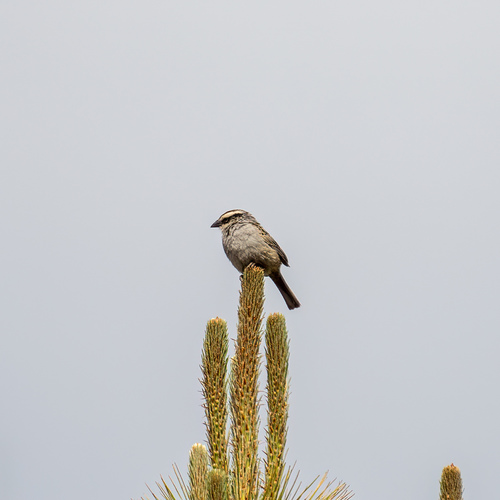
Olive Warbler

Olive Warbler

Peucedramus taeniatus

Silhouette: Sheatherius · PhyloPic

LCLeast ConcernNTVUENCR
Daily sighting probability ~10% · With luck
at Toluca

In 3 days ~30% in a week ~60%

27 Verified sightings at Toluca
156 In all 4 parks From 2019 to 2026
September Best month
☀️ Diurnal When it's spotted

About the Olive Warbler

The olive warbler (Peucedramus taeniatus) is a small passerine bird. It is the only member of the genus Peucedramus and the family Peucedramidae. This species breeds from southern Arizona and New Mexico, USA, south through Mexico to Nicaragua. It is the only bird family endemic to North America (including Central America). It was in the past classed with the Parulidae (New World warblers), but DNA studies suggest that it split early from the other related passerines, prior to the differentiation of the entire New World warbler/American sparrow/Icterid group. It is therefore now given a family of its own.

It is an insectivorous species of coniferous forests. Though it is often said to be non-migratory, most New Mexican birds leave the state from November to late February. It lays 3–4 eggs in a tree nest. The olive warbler was originally placed in the New World warbler (family Parulidae) genus Dendroica, a group which it closely resembles, particularly in having nine primaries and similar skin. In spite of being assigned to its own genus in 1875, its affinities were a source of contention. The shape of the basihyal bone in the skull, and aspects of its behaviour led to... Wikipedia →

Sounds

Song0:33

Mexico · 2025

© Barry Edmonston · XC1001158 · CC BY-NC-SA 4.0

Call0:20

Mexico · 2024

© Joren van Schie · XC956572 · CC BY-NC-SA 4.0

Begging call0:25

Mexico · 2016

© Manuel Grosselet · XC324452 · CC BY-NC-SA 4.0

Global Distribution

Parks Where Found

# Park Country Daily sighting probability
1 Reserva de la Biosfera Mariposa Monarca 🇲🇽 Mexico
~10%
2 Celaque National Park 🇭🇳 Honduras
~10%
3 Cumbres de Monterrey National Park 🇲🇽 Mexico
<5%
4 La Tigra National Park 🇭🇳 Honduras
<5%

Cities Where Found

# City Country Daily sighting probability
1 Toluca 🇲🇽 México
~10%
2 Mexico City 🇲🇽 México
<5%
3 Guatemala City 🇬🇹 Guatemala
<5%

Before you go

What are the chances of seeing an Olive Warbler in Toluca?

With luck

About 10% of wildlife watchers report an Olive Warbler sighting in Toluca on a given day, based on 27 verified sightings from GBIF citizen-science data. It is the 61st most-seen of the 118 birds we can rate there. Over three days the chance rises to about 30%, and over a week to about 60%, if each day is a fresh chance.

When is the best time to see an Olive Warbler in Toluca?

September

In that month about 40% of wildlife watchers report an Olive Warbler in Toluca on a given day, against under 5% in February, the lowest month. That is one of Toluca's wettest months, with about 150 mm of rain against 5 mm in December.

What time of day is best to see an Olive Warbler?

Between 8 and 11 am

Across all the parks we cover, that three-hour window holds the most Olive Warbler sightings with a recorded time, and about 9 in 10 of them come between 6 am and 6 pm: it is a daytime animal.

Is Toluca the best place to see an Olive Warbler?

Yes

Of the 3 cities where we can rate Olive Warbler sightings, Toluca has the highest daily chance: about 10%. Next come Mexico City (México, under 5%) and Guatemala City (Guatemala, under 5%).

Which relatives of the Olive Warbler live in Toluca?

Same order: Passeriformes

The closest relatives of the Olive Warbler that you can see in Toluca (order Passeriformes, Perching Birds) are House Finch (about 80%), Canyon Towhee (about 80%) and Bushtit (about 70%), with each one's daily chance of a sighting.

Where does the Olive Warbler sighting chance come from?

GBIF citizen-science records

It is estimated from how often the Olive Warbler is recorded against all the birds logged in Toluca (27 verified sightings), calibrated against known sighting rates. Figures are rounded to the nearest 10% because citizen-science data supports honest approximations, not decimals, and months with records from fewer than five people show "—". How it works.

← Back to Toluca